Cerebral Palsy Birth Injury Claims in Michigan: When Negligence at Delivery Causes Permanent Disability
Cerebral palsy is the most common motor disability of childhood. The Centers for Disease Control estimates that roughly 1 in every 345 children in the United States is diagnosed with it. The majority of cases are not caused by medical error — they are the result of prenatal events that no one could have prevented. But a meaningful subset of cerebral palsy cases are caused by medical negligence at labor or delivery, and when that is what happened, Michigan law provides a path to compensation that can fund a lifetime of care.
If you are a Michigan parent of a child diagnosed with cerebral palsy, this article explains how the law evaluates birth injury cases, what damages are recoverable, and what every family needs to know about the deadlines that govern these claims. Birth injury cases are among the most complex — and most consequential — claims in personal injury law. Understanding the framework is the first step.
What Cerebral Palsy Is — and What "Birth Injury" Means Legally
Cerebral palsy is a group of permanent movement and posture disorders caused by damage to the developing brain. It can result in spasticity, dystonia, impaired coordination, intellectual disability, seizures, and in severe cases, the inability to walk, speak, or eat without assistance. There is no cure. Treatment is lifelong and expensive.
In personal injury terms, a "birth injury" is a harm that occurred during labor, delivery, or the immediate neonatal period — and that was caused, in whole or in part, by a deviation from the medical standard of care. The most common mechanism in cerebral palsy birth injury cases is hypoxic-ischemic encephalopathy (HIE) — brain injury caused by the deprivation of oxygen and blood flow to the baby's brain at or near the time of birth. When obstetricians, labor and delivery nurses, or the hospital fails to recognize and respond to fetal distress, that oxygen deprivation can cause the cellular damage that becomes cerebral palsy.
When Negligence at Delivery Causes Cerebral Palsy
The fact patterns that drive birth injury cerebral palsy claims are remarkably consistent. The recurring negligence categories include:
- Failure to monitor the fetal heart rate. Continuous electronic fetal monitoring (EFM) is the standard of care during labor in most U.S. hospitals. The strips show oxygenation status in real time. Patterns called "late decelerations," "variable decelerations," and the absence of variability are warning signs of fetal distress. When nurses and physicians miss them — or document them but fail to act — minutes matter.
- Failure to perform a timely C-section. When fetal distress is identified, the standard of care requires delivery — by emergency cesarean if vaginal delivery is not imminent. The professional benchmark is the 30-minute decision-to-incision rule: from the moment a non-reassuring tracing is identified, the baby should be delivered within 30 minutes. Delays of an hour or more, even where staff is on site, are often the central liability fact in a CP case.
- Improper use of forceps or vacuum extraction. Operative vaginal delivery has a defined role and defined contraindications. Excessive force, improper placement, or use after a failed prior attempt can cause skull fracture, intracranial hemorrhage, or brachial plexus injury.
- Mismanagement of shoulder dystocia. When the baby's shoulder lodges behind the maternal pubic bone, the obstetric team must execute defined maneuvers in a defined order (McRoberts, suprapubic pressure, etc.). Repeated downward traction on the head causes brachial plexus injury and, when prolonged, oxygen deprivation.
- Failure to manage maternal conditions. Untreated pre-eclampsia, undiagnosed gestational diabetes, untreated maternal infection, or failure to administer Rh immunoglobulin can each contribute to a brain injury at delivery.
- NICU negligence. Birth injuries are sometimes caused or worsened in the neonatal intensive care unit — by missed seizures, untreated jaundice (kernicterus), failure to cool the brain (therapeutic hypothermia is the standard for moderate-to-severe HIE), medication errors, or delays in transfer to a higher-level NICU.
None of these failures, standing alone, automatically equals a viable claim. The legal question is always whether a reasonably competent provider in the same specialty would have done something different — and whether that difference would have prevented the injury. That question is answered by expert physicians, not lawyers.
How Michigan Law Treats Birth Injury Claims
Birth injury claims in Michigan are a subset of medical malpractice. They follow the procedural requirements of the Michigan Medical Malpractice Reform Act and are subject to its damages caps, expert requirements, and pre-suit procedures.
Three things every Michigan parent should know about the legal framework:
- Pre-suit notice and an Affidavit of Merit are mandatory. Before a malpractice lawsuit can be filed in Michigan, the family must serve a Notice of Intent to File suit (MCL § 600.2912b) and, with the complaint, file an Affidavit of Merit signed by a qualified expert in the same specialty as the defendant (MCL § 600.2912d). Skipping these steps voids the case. They are not boilerplate — they require an expert review of the medical record, which takes time.
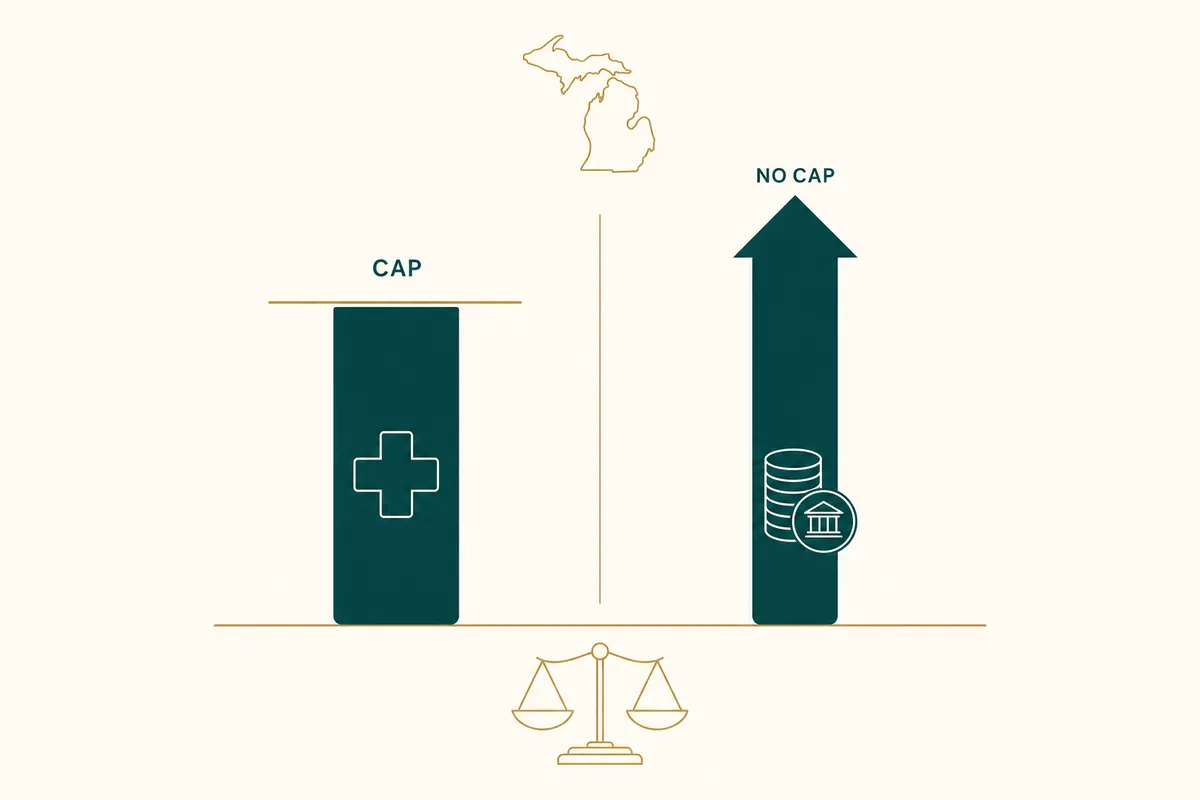
- The non-economic damages cap does not apply the same way to children. Michigan's statutory cap on non-economic damages (MCL § 600.1483) is adjusted annually but for adults runs in the low six figures for ordinary cases and a higher tier for catastrophic injury. Critically, the cap was designed for adults — and birth injury cases producing permanent neurological damage almost always meet the criteria for the higher tier, which still applies but at a meaningfully larger amount. Economic damages — medical care, lost earning capacity, life-care plan costs — are not capped.
- Filing deadlines for birth injuries involving minors are extended — but they are technical, and shorter than most parents expect. Michigan tolls medical malpractice claims for minors under specific provisions of MCL § 600.5851 and the medical malpractice statute of repose. Birth injury claims involving newborns enjoy meaningful extension past the standard two-year filing window, but the outer limit can arrive sooner than parents realize. A diagnosis at age 4 with action delayed until age 9 may already be too late. Parents who suspect their child's cerebral palsy was preventable should consult a Michigan medical malpractice attorney as soon as that suspicion forms.
What Cerebral Palsy Birth Injury Cases Are Worth
Cerebral palsy birth injury cases are among the highest-value claims in personal injury law for one reason: the damages are catastrophic and lifelong. A child with severe spastic quadriplegic cerebral palsy may require:
- Multiple orthopedic surgeries through childhood and adulthood
- Lifelong physical, occupational, and speech therapy
- Specialized adaptive equipment — wheelchairs, communication devices, hospital beds, lift systems
- Home modifications — ramps, widened doorways, accessible bathrooms
- Skilled nursing care, in many cases 24 hours a day for the child's entire life
- Vehicle modifications and accessible transportation
- Nutritional support — feeding tubes, formulas, gastrointestinal management
- Anti-seizure medications and lifelong neurological monitoring
A board-certified life-care planner builds these costs into a present-value figure — typically supported by a vocational economist projecting the lost earning capacity the child would have had absent the injury. In severe cases, the resulting damages calculation runs into eight figures. Settlements and verdicts in this range are not unusual when liability is clear and damages are well-documented.
Koussan Law's trial experience includes a $14.95 million jury verdict against Pontiac General Hospital in a sexual assault and institutional negligence case, among the largest civil verdicts in recent Michigan history. That experience informs how we evaluate and prepare every birth injury case we accept.
Five Things That Strengthen a Cerebral Palsy Birth Injury Case
- The complete medical record. Labor and delivery records, fetal heart rate strips (paper or electronic), nursing notes, anesthesia records, pediatric records from the first hours of life, NICU notes, MRI imaging from the neonatal period. The hospital must produce these on request. Cases lose value — and sometimes fail entirely — when records are incomplete or strips were never preserved.
- Imaging consistent with acute peripartum injury. A neonatal MRI showing the pattern of injury characteristic of acute hypoxic-ischemic events at the time of birth is one of the most important single pieces of evidence. Imaging can also rule out prenatal causes (such as a stroke in utero) that would defeat the claim.
- Qualified experts in the right specialties. A board-certified obstetrician on standard of care. A pediatric neuroradiologist on imaging. A pediatric neurologist on causation and prognosis. A life-care planner on damages. The cost of these experts can run into the hundreds of thousands of dollars per case — which is why these cases are typically taken on contingency by firms that fund the litigation.
- Documentation of the child's current condition and prognosis. Functional assessments, IEPs, therapy progress reports, the family's daily caregiving log. The defense will scrutinize the severity of the injury; well-documented impairment is essential.
- Trial-readiness. Birth injury defense counsel and their carriers settle these cases when they believe trial is a credible threat. They do not settle them based on demand letters alone. Filing the case, completing discovery, deposing the obstetrician and the labor and delivery nurses, and preparing the experts for trial is what produces seven- and eight-figure resolutions.
What to Do If You Suspect Negligence Caused Your Child's Cerebral Palsy
- Request the complete medical record now. You have a right to your child's medical records. Request the labor and delivery records, the fetal monitoring strips, the NICU records, and any neonatal imaging. Hospitals have a defined timeframe to respond.
- Document your child's condition. Keep copies of every diagnosis, evaluation, IEP, therapy report, and home video that documents your child's day-to-day function. Years from now, this documentation will be used to demonstrate damages.
- Do not sign anything from the hospital's risk department or insurer without counsel. Some hospitals offer modest settlements or releases early — well below what the case is worth — in exchange for a release that ends all future claims. Decline politely until counsel reviews the offer.
- Consult a Michigan birth injury attorney. Every birth injury case is fact-specific. Most reputable Michigan birth-injury firms will conduct a free initial review of the records, at no cost, and will tell you honestly whether they believe a viable claim exists. The earlier you start, the more options you have.
How Koussan Law Handles Birth Injury Cases
We accept cerebral palsy and other birth injury claims on contingency. You pay nothing unless we recover. We front the cost of medical-record retrieval, expert consultations, imaging review, and litigation. Our trial experience, including the $14.95 million verdict against Pontiac General Hospital, is built into how we evaluate every case.
If your child has been diagnosed with cerebral palsy, hypoxic-ischemic encephalopathy, Erb's palsy, or another birth-related injury, contact us for a free consultation. We will review the records and tell you, honestly, whether we believe the standard of care was breached. Request a consultation, use our free case calculator, or call (313) 800-0000.
Related Practice Areas
- Birth Injuries
- Medical Malpractice
- Wrongful Death
- Catastrophic Injury
- Erb’s Palsy and Brachial Plexus Birth Injury in Michigan
Past results do not guarantee future outcomes. Every birth injury case is fact-specific and depends on the medical record, the applicable standard of care, and qualified expert review. This article is for general informational purposes only and is not legal advice. Reading this article does not create an attorney-client relationship with Koussan Law.