Medical Malpractice
Michigan Medical Malpractice Cases Are Hard. That's Why They Demand the Right Firm.
Let's be upfront: medical malpractice is the most procedurally demanding area of personal injury law in Michigan. Before a lawsuit can even be filed, the case needs a Notice of Intent, an Affidavit of Merit from a qualified medical expert, and it must navigate damage caps that don't apply to any other type of injury case. The costs of prosecuting these claims, including expert witnesses, medical record reviews, and depositions of physicians, run into six figures before anyone ever sees a courtroom.
That is exactly why most Michigan personal injury firms decline med mal cases. Koussan Law does not handle medical malpractice claims directly. Instead, we maintain referral relationships with experienced firms that have the resources, the expert network, and the appetite for this kind of litigation. When a surgeon leaves a sponge inside a patient, when an ER misreads a scan and sends someone home with an undiagnosed brain bleed, or when a delayed cancer diagnosis costs someone years of their life, that case deserves a firm built for it. Contact Koussan Law and we will connect you with an experienced medical malpractice firm in our referral network for a free, no-obligation consultation.
The Procedural Gauntlet Michigan Puts in Your Way
Before filing suit, MCL § 600.2912b requires a detailed Notice of Intent (NOI) to be sent to every healthcare provider a claimant intends to sue. The NOI must lay out the standard of care, how it was breached, and how that breach caused the injury. Then comes a waiting period, 182 days, before the actual lawsuit can be filed. During that waiting period, the defense is building its case, and the claimant's side should be too.
When the suit is filed, MCL § 600.2912d requires an Affidavit of Merit, a sworn statement from a qualified medical expert in the same specialty confirming the provider breached the standard of care and that breach caused the injury. No affidavit, no case. The court will dismiss it. Otherwise valid claims have died because the attorney used an expert who wasn't in the right specialty or whose affidavit didn't satisfy the statutory requirements. This is one reason the choice of firm matters so much, and why Koussan Law refers these matters to firms that handle them every day.
The Damage Cap Reality
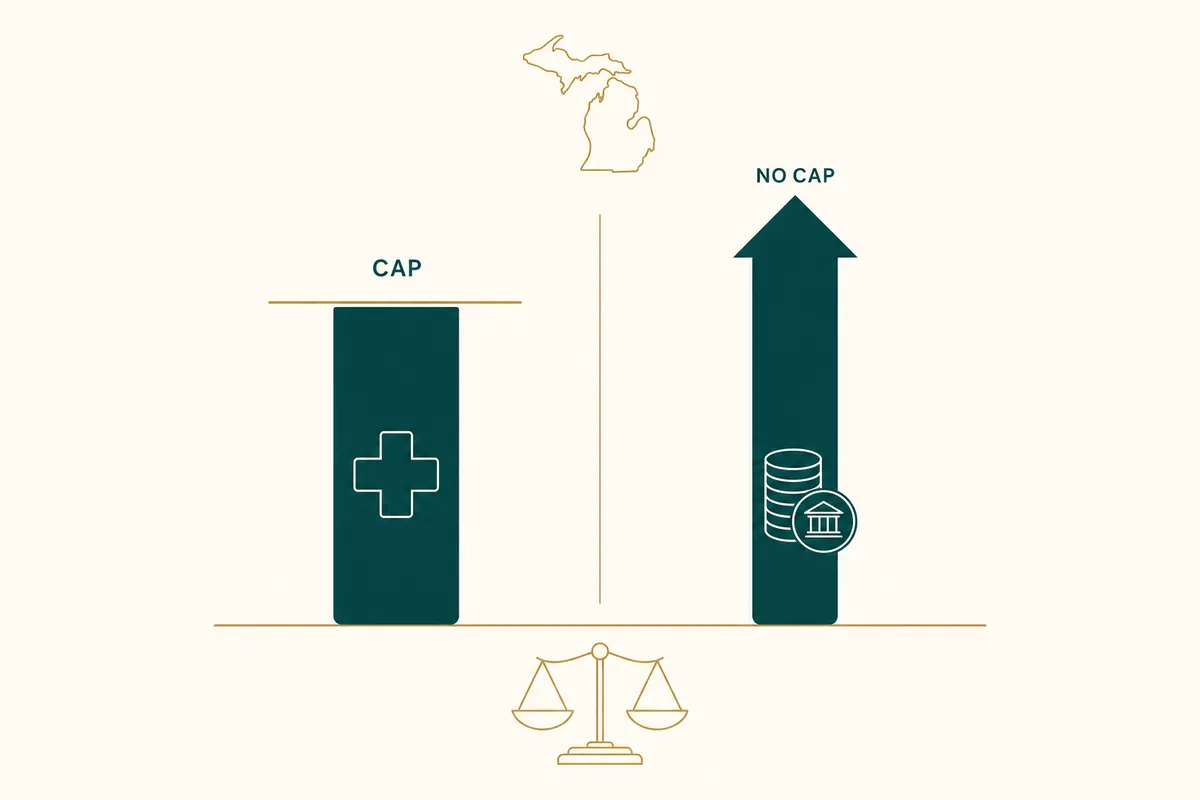
Michigan is one of the states that caps non-economic damages (pain and suffering) in medical malpractice cases under MCL § 600.1483. The cap adjusts annually for inflation. For 2026, the standard cap is $596,400, with a higher cap of $1,065,000 reserved for the most catastrophic injuries — permanent functional loss of one or more limbs caused by brain or spinal cord injury, permanently impaired cognitive capacity, or permanent loss of reproductive capacity. Economic damages, such as medical bills, lost wages, and future care needs, are not capped. This is why thorough documentation of every economic loss matters enormously in med mal cases.
Frequently Asked Questions
Q: What is the Notice of Intent requirement in Michigan medical malpractice?
Under MCL § 600.2912b, a detailed written notice must be sent to each healthcare provider at least 182 days before filing suit. The notice must explain what the standard of care was, how the provider breached it, and how that breach caused the injuries. This isn't optional, it's a mandatory prerequisite to filing. In some cases the NOI alone prompts an early settlement discussion when the medical evidence is that clear.
Q: What is an Affidavit of Merit?
Under MCL § 600.2912d, the complaint must include a sworn statement from a qualified medical expert, typically a physician in the same specialty as the defendant, confirming breach of the standard of care and causation. If the affidavit doesn't meet statutory requirements, the court dismisses the case. Getting this right is non-negotiable, and it's one of the first things an experienced med mal firm evaluates.
Q: What is the statute of limitations for medical malpractice in Michigan?
Two years from the date of the malpractice under MCL § 600.5805(8), not the date it was discovered. There's a limited discovery exception that extends the deadline up to six months after the injury reasonably should have been discovered, but there's an absolute ceiling of six years. For minors, the deadline extends to age 10. Because the case also needs 182 days for the NOI period, the practical filing window is even shorter than it looks.
Q: Are damages capped in Michigan medical malpractice cases?
Non-economic damages are capped under MCL § 600.1483. The caps adjust annually for inflation; for 2026 they are $596,400 for most cases and $1,065,000 for the most severe injury categories. Economic damages, including medical costs, lost income, and future care, have no cap. This is why building the economic damages case thoroughly is critical. Every dollar of future medical treatment, every hour of lost earning capacity, and every day of required attendant care needs to be documented and projected by qualified experts.