Michigan No-Fault Auto Insurance Explained: The Complete 2026 Guide
Short answer: Michigan is a no-fault auto insurance state. Your own insurer pays your medical bills, lost wages, and replacement services through Personal Injury Protection (PIP) benefits — regardless of who caused the crash. You can still sue the at-fault driver for pain and suffering only if your injury meets a specific legal threshold under MCL § 500.3135 (death, serious impairment of body function, or permanent serious disfigurement). The 2019 reform (effective July 2020) replaced mandatory unlimited PIP with five coverage tiers, fundamentally changing what "full coverage" means in Michigan.
Last updated 2026-05-18 by Ali H. Koussan, Founding Attorney at Koussan Law. This guide covers Michigan's no-fault system as it operates today — the most current statutory framework, the 2019 reform, and the practical decisions every Michigan driver and accident victim faces.
What Is Michigan No-Fault Insurance, Exactly?
Michigan's no-fault auto insurance system is governed by the Michigan No-Fault Act, MCL § 500.3101 et seq. Under no-fault, your own auto insurance pays your Personal Injury Protection (PIP) benefits after a crash, regardless of who was at fault. This is fundamentally different from a "tort" state, where the at-fault driver's insurer is the first source of recovery for everyone involved.
Michigan adopted no-fault in 1973 with one purpose: get medical care to injured drivers without the delay of proving fault. The system works at that goal — your benefits start flowing as soon as your claim is filed, often within days. But it comes with two major trade-offs. First, your own insurer becomes your adversary on the medical-benefits side, because they pay your bills and have every incentive to limit what they cover. Second, you cannot sue the at-fault driver for medical expenses already paid by PIP — those costs are off the table for third-party recovery.
What PIP Benefits Cover in Michigan
Under MCL § 500.3107, Michigan PIP benefits cover four categories:
- Allowable medical expenses — hospital bills, surgery, physical therapy, prescriptions, medical equipment, attendant care, and rehabilitation. Subject to your elected PIP coverage tier and Michigan's medical fee schedule (added by the 2019 reform).
- Wage loss benefits — 85 percent of your gross income, capped at a statutory monthly maximum (adjusted annually for inflation), paid for up to three years from the date of the accident.
- Replacement services — $20 per day toward services you can no longer perform yourself (housekeeping, lawn care, child care), for up to three years.
- Survivor's loss benefits — paid to dependents if the insured is killed in the crash. Lost income plus replacement services, paid for three years.
PIP benefits are mandatory for every Michigan-registered vehicle. If you have no auto policy, the Michigan Assigned Claims Plan (MCL § 500.3171) may be your only source of PIP after a crash — with strict deadlines and reduced benefits.
The 2019 Reform: The Five PIP Coverage Tiers
Before the 2019 reform, every Michigan driver paid for unlimited lifetime medical PIP benefits. That changed when the legislature passed PA 21 and 22 of 2019, effective July 2, 2020. Under MCL § 500.3107c, drivers now choose one of five PIP medical coverage levels at policy issuance and renewal:
- Unlimited PIP — the legacy default. No cap on medical benefits for the life of the injured person.
- $500,000 PIP — covers up to $500,000 in medical expenses.
- $250,000 PIP — covers up to $250,000 in medical expenses.
- $50,000 PIP — only available to Medicaid recipients who also carry qualifying private health insurance.
- PIP opt-out — only available if every named insured and resident spouse has qualifying Medicare coverage (Parts A and B).
The trade-off is direct: lower PIP coverage = lower premium, but exponentially greater financial exposure if you suffer a catastrophic injury. A traumatic brain injury or spinal cord injury can easily exceed $500,000 in lifetime medical care. We have represented clients who elected the $50,000 tier to save approximately $40 per month and ended up with hundreds of thousands of dollars in uncovered medical bills. Choose your PIP tier as if your life depends on it, because it does.
When You Can Sue the At-Fault Driver: The MCL § 500.3135 Threshold
Michigan's no-fault system does not eliminate your right to sue the driver who caused the crash. It restricts that right to specific categories of harm. Under MCL § 500.3135, you can pursue a third-party tort claim against the at-fault driver only if your injuries result in one of three outcomes:
- Death. Wrongful death claims proceed regardless of PIP.
- Permanent serious disfigurement. Scarring, amputation, severe burns, or other permanent visible injury.
- Serious impairment of body function. Defined by the statute and Michigan Supreme Court precedent (McCormick v. Carrier, 487 Mich. 180 (2010)) as an objectively manifested impairment of an important body function that affects the injured person's general ability to lead his or her normal life.
Common injuries that meet the serious-impairment threshold: documented disc herniations, fractures requiring surgical hardware, traumatic brain injuries with objective neuropsychological deficits, ligament tears requiring reconstructive surgery, and chronic pain conditions confirmed by imaging. Soft tissue injuries without objective findings frequently fall short. The threshold analysis is fact-specific and litigation-driven — a competent attorney can make or break the case on this issue alone.
If the threshold is met, the at-fault driver's insurer pays for pain and suffering, loss of enjoyment of life, and economic damages above what PIP covered. Damages are not capped in Michigan auto-accident cases (unlike medical malpractice).
The Mini-Tort: Recovering Vehicle Damage
Under MCL § 500.3135(3)(e), you can recover up to $3,000 in vehicle damage from the at-fault driver, in excess of what your collision coverage pays. This applies when the other driver was more than 50 percent at fault. The mini-tort is separate from the third-party tort claim and does not require meeting the serious-impairment threshold. The cap was raised from $1,000 to $3,000 in 2019.
The Three Deadlines Every Michigan Accident Victim Must Know
Missing one of these deadlines bars your claim, regardless of how strong the underlying facts are.
- One-year PIP deadline (MCL § 500.3145). You must apply for PIP benefits within one year of each individual loss (medical bill, missed paycheck, etc.). Many people don't realize this until benefits they assumed were automatic get denied. File the initial PIP claim immediately, even if you don't yet know the full scope of your injuries.
- Three-year tort deadline (MCL § 600.5805). You have three years from the date of the accident to file a third-party negligence lawsuit against the at-fault driver. Government-entity defendants (state, county, MDOT) require a 120-day written notice under MCL § 691.1404 in addition to the three-year deadline.
- Mini-tort one-year deadline (MCL § 500.3145). Same one-year limit as PIP applies to the $3,000 vehicle damage claim.
These deadlines are absolute. Michigan courts almost never grant equitable extensions.
Priority Rules: Which Insurer Pays Your PIP?
One of the most procedurally complex areas of Michigan no-fault is determining which insurer is responsible for your PIP benefits. The rules are codified in MCL § 500.3114 and § 3115, and they have generated decades of appellate litigation. The general priority order:
- The injured person's own auto policy.
- The auto policy of a resident relative.
- The auto policy of the vehicle's owner or operator.
- The Michigan Assigned Claims Plan (last resort, reduced benefits).
Exceptions and special rules apply to motorcycle accidents, pedestrians, passengers, and out-of-state visitors. Getting the priority analysis wrong at the start of a case can cost months of delayed benefits and tens of thousands of dollars.
Common Mistakes That Wreck Michigan No-Fault Claims
- Not seeking medical care on the day of the accident. Insurers use treatment gaps to deny PIP and reduce settlement value. Even if you feel "fine," go to the ER, urgent care, or your primary doctor the same day.
- Giving a recorded statement to the at-fault driver's insurer. They will use anything you say against you. Politely decline until you've consulted counsel.
- Accepting a lowball PIP-tier offer at policy renewal. The premium savings on a $50,000 tier vs. unlimited PIP is typically $50-100/month. The financial exposure delta in a catastrophic injury is six or seven figures.
- Filing PIP claims late. One-year deadlines are unforgiving. Apply immediately, then keep updating with each new loss.
- Missing the 120-day government notice. Crashes involving MDOT vehicles, county trucks, or city snowplows require written notice within 120 days, separate from the three-year deadline.
- Settling the third-party claim before MMI. Settle a third-party tort claim before reaching Maximum Medical Improvement and you forfeit recovery for the full future damages picture.
Frequently Asked Questions About Michigan No-Fault
What does "no-fault" actually mean in Michigan?
No-fault means your own auto insurer pays your initial medical expenses, wage loss, and other PIP benefits regardless of who caused the accident. It does not mean no one is liable — you can still sue the at-fault driver for pain and suffering if your injury meets the MCL § 500.3135 threshold.
Is Michigan a no-fault state?
Yes. Michigan is one of 12 no-fault states and operates under the Michigan No-Fault Act, MCL § 500.3101 et seq. Michigan's system was historically unique for requiring unlimited PIP medical coverage; the 2019 reform made coverage tiered.
How long do I have to file a Michigan no-fault PIP claim?
One year from the date of each individual loss under MCL § 500.3145. File the initial application immediately after the accident. Each subsequent medical bill, lost wage period, or replacement-service expense has its own one-year clock.
How long do I have to sue the at-fault driver in Michigan?
Three years from the date of the accident under MCL § 600.5805. Claims against government entities require a separate 120-day written notice under MCL § 691.1404.
Can I sue if I was partially at fault for the accident?
Yes. Michigan follows modified comparative negligence under MCL § 500.3135(2). Your damages are reduced by your percentage of fault. Only fault greater than 50 percent bars non-economic damages (pain and suffering), so at exactly 50 percent you still recover them. Even past that line, economic damages such as medical bills and lost wages remain recoverable, reduced by your percentage of fault.
What is the serious-impairment-of-body-function threshold?
Defined by MCL § 500.3135 and refined by McCormick v. Carrier, the threshold requires an objectively manifested impairment (something a medical professional can verify, not just self-reported pain) of an important body function (one that has value and significance) that affects the plaintiff's general ability to lead his or her normal life. Disc herniations, fractures with hardware, ligament tears, and documented TBIs typically meet the standard.
How much PIP coverage should I choose?
Unlimited PIP if you can afford the premium. The annual savings on lower tiers ($300-$1,200 in most cases) are rarely worth the catastrophic-injury exposure. If you must choose a lower tier, $500,000 is the practical minimum for most working adults. Avoid $50,000 PIP unless you have rock-solid private health insurance that covers auto-injury claims (most policies have auto-injury exclusions).
What is mini-tort in Michigan?
Mini-tort is a limited claim under MCL § 500.3135(3)(e) allowing you to recover up to $3,000 in vehicle damage from the at-fault driver, in excess of your collision coverage payout. The other driver must have been more than 50 percent at fault. The deadline is one year.
Does Michigan no-fault cover passengers?
Yes. If you are a passenger, the priority rules in MCL § 500.3114 determine which insurer pays your PIP. Usually it is the passenger's own auto policy, then a resident relative's policy, then the vehicle's policy.
What about pedestrians and bicyclists?
Pedestrians and bicyclists struck by a motor vehicle are entitled to PIP benefits from the vehicle's no-fault insurer (or their own policy if a resident relative). Michigan is unusually generous to non-motorist victims in this respect.
Are motorcycles covered by no-fault?
Motorcycles are excluded from the no-fault PIP system under MCL § 500.3105(2). A motorcyclist injured in a crash with a motor vehicle gets PIP from the involved auto's insurer (or a resident relative's auto policy). Motorcycle-only single-vehicle crashes do not generate PIP. Helmet-law and threshold issues add additional complexity to motorcycle claims.
Can I recover lost wages under no-fault?
Yes. PIP pays 85 percent of gross income up to a statutory monthly cap, for up to three years from the accident. If your earnings exceed the cap, the at-fault driver's third-party policy may cover the difference — but only if you meet the serious-impairment threshold.
What is a Michigan no-fault medical fee schedule?
The 2019 reform added a medical fee schedule capping what auto insurers pay for medical services. The schedule references Medicare rates plus a multiplier that varies by service type. The fee schedule has caused many medical providers to refuse no-fault patients or significantly limit their volume. This has created a real-world access-to-care problem for catastrophically injured Michiganders.
Do I need a Michigan no-fault attorney?
If you have serious injuries, yes. The combination of priority disputes, threshold litigation, fee-schedule complications, IME (insurance medical examination) pressure, and aggressive insurer tactics makes no-fault one of the most procedurally hostile areas of personal injury law. Most Michigan no-fault attorneys work on contingency — you pay nothing unless we recover. The cost of getting it wrong without counsel is almost always greater than the cost of representation.
How long does a Michigan no-fault case take?
PIP benefits should start within 30 days of a properly submitted application. Third-party tort cases typically take 12 to 36 months to resolve, depending on injury severity, treatment trajectory, and whether the case settles or goes to trial. Catastrophic cases involving disputed liability or expert-heavy damages can take longer.
How Koussan Law Handles Michigan No-Fault Cases
We accept Michigan auto-accident cases on contingency — you pay nothing unless we recover. We have secured a $14.95 million jury verdict against Pontiac General Hospital in a sexual assault and institutional negligence case, a $6 million slip-and-fall settlement, and a $1.85 million TBI settlement from auto-related cases. Our offices serve all of Michigan from Detroit, Dearborn Heights, and Marquette.
If you have been injured in a Michigan auto accident, call (313) 800-0000 for a free consultation, request a consultation online, or use our free case calculator to estimate your claim's value.
Related Practice Areas and Resources
- Automotive Accidents — our primary auto-accident landing page
- Trucking Accidents
- Motorcycle Accidents
- Traumatic Brain Injury (TBI)
- Catastrophic Injury
- Wrongful Death
- Mild TBI After a Michigan Car Accident: Why Insurance Companies Deny These Claims
- All Michigan Locations
Last updated 2026-05-18. Past results do not guarantee future outcomes. Every auto accident case is fact-specific. This article is for general informational purposes only and is not legal advice. Reading this article does not create an attorney-client relationship with Koussan Law.
For a deeper dive into your benefits, see our complete guide to PIP insurance in Michigan.
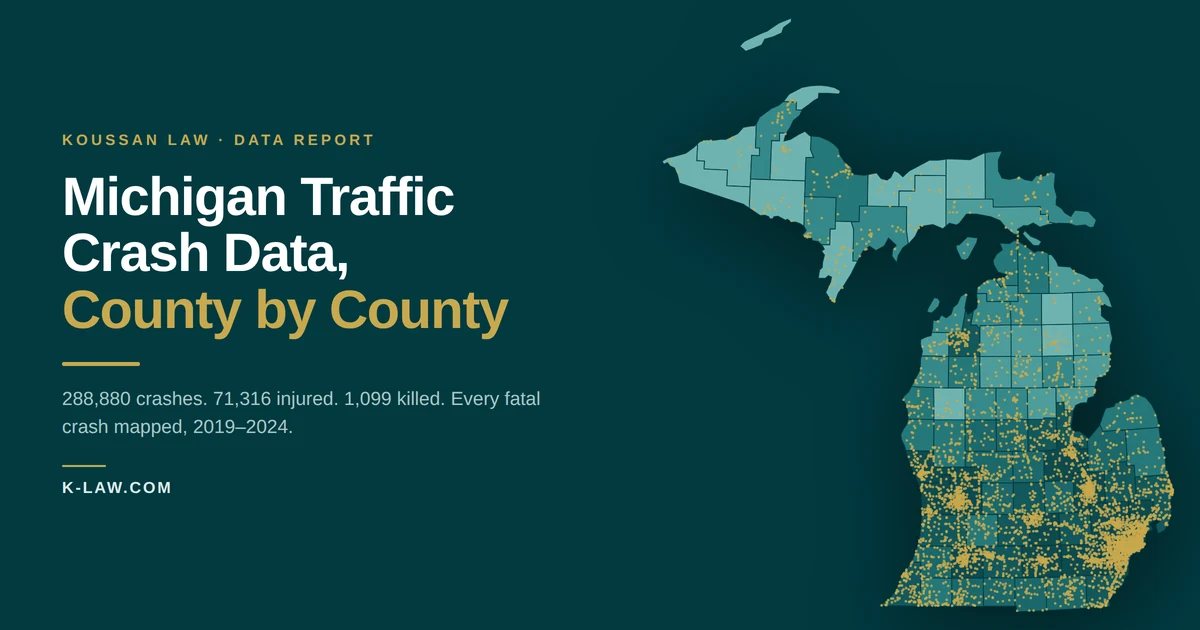
Related data: Michigan traffic crash data by county, covering all 83 counties for 2024.