How to Sue for Emotional Distress in Michigan: A Step-by-Step Guide
Short answer: In Michigan, you can sue for emotional distress in two ways. (1) As part of a broader personal injury claim — emotional distress is compensable as a component of pain and suffering once you clear the MCL § 500.3135 serious-impairment-of-body-function threshold (auto cases) or once any physical injury is established (non-auto cases). (2) As a standalone claim for Intentional Infliction of Emotional Distress (IIED) or Negligent Infliction of Emotional Distress (NIED) — both have specific evidentiary requirements. Damages in Michigan emotional distress cases are not formula-based: juries award what the medical evidence and the plaintiff's testimony support. Settlement values range from a few thousand dollars for minor distress to high six figures or more for diagnosed, treatment-documented PTSD and lasting psychological injury.
This guide walks through the actual process — the legal standards, the medical documentation that builds the case, the damages categories, and the realistic settlement ranges Michigan emotional distress claims produce in 2026.
The Six Steps to Suing for Emotional Distress in Michigan
- Document the triggering incident. Whether it's a car accident, a workplace harassment incident, witnessing harm to a family member, or any other event causing severe emotional distress, the underlying incident must be documented with police reports, witness statements, photographs, and any contemporaneous records.
- Seek mental health treatment immediately. A documented record of treatment with a licensed psychiatrist, psychologist, LCSW, or LPC is the single most important piece of evidence in any Michigan emotional distress case. Gaps in treatment, or no treatment at all, are the leading reason emotional distress claims under-resolve.
- Get a formal diagnosis. Post-traumatic stress disorder (PTSD), generalized anxiety disorder, major depressive disorder, adjustment disorder, panic disorder — a DSM-5 diagnosis from a treating mental health professional anchors the claim. Without diagnosis, defense argues the distress is "just upset" and not legally severe.
- Keep a symptom journal. Daily notes documenting symptoms (sleep loss, intrusive memories, panic episodes, avoidance, hypervigilance, depression, suicidal ideation), their frequency, severity, and the impact on work, relationships, and daily function. Contemporaneous notes are more credible than reconstructed testimony.
- Consult a Michigan personal injury attorney within weeks, not months. The statute of limitations is generally three years from the triggering incident under MCL § 600.5805. Government-entity defendants require a separate 120-day written notice under MCL § 691.1404. Evidence quality also degrades with time.
- Build the case with expert testimony. Your treating mental health professional may need to testify that the distress is causally connected to the incident and that the diagnosis is severe. In stronger cases, an independent forensic psychiatrist or psychologist supplements treatment records with comprehensive evaluation and prognosis.
Two Legal Theories: IIED and NIED
Michigan recognizes two distinct emotional distress causes of action.
Intentional Infliction of Emotional Distress (IIED) requires:
- Extreme and outrageous conduct by the defendant — conduct so extreme that it "exceeds all possible bounds of decency" and is intolerable in a civilized society. This is a high bar. Routine rudeness, insults, or even harassment that wouldn't shock a reasonable person does not qualify.
- Intent or recklessness as to the emotional consequences.
- Severe emotional distress — distress that no reasonable person should be expected to endure.
- Causation between the conduct and the distress.
Examples of conduct Michigan courts have found sufficient for IIED include: a debt collector's pattern of harassment combined with threats of bodily harm; an employer's deliberate exposure of a worker to a known traumatic situation; a landlord's deliberate destruction of a tenant's property combined with threats.
Negligent Infliction of Emotional Distress (NIED) is more limited in Michigan. The leading framework comes from Daley v. LaCroix, 384 Mich. 4 (1970), and subsequent case law. NIED typically requires:
- The plaintiff witnessed a sudden negligent act causing injury or death to a closely related family member;
- The plaintiff suffered immediate and severe emotional distress as a result;
- The distress produced a definite and objective physical injury (the "physical manifestation" requirement Michigan courts continue to apply, though with some flexibility); and
- The negligent conduct foreseeably created risk of emotional harm.
Most emotional distress claims arising from personal injury accidents are not standalone NIED claims. They are pursued as pain and suffering damages within the broader negligence case — easier to prove and unconstrained by the bystander/foreseeability rules.
Emotional Distress in Michigan Auto Cases: The Threshold
For automobile accidents, Michigan's No-Fault Act under MCL § 500.3135 requires you to clear the serious-impairment-of-body-function threshold before you can recover pain and suffering — including emotional distress damages — from the at-fault driver. The threshold is met when your injuries are objectively manifested, affect an important body function, and affect your general ability to lead your normal life. Documented PTSD or major depressive disorder following a serious crash often satisfies the threshold; minor anxiety following a fender-bender typically does not.
For the complete no-fault framework, see our Michigan No-Fault Insurance Explained guide. For PIP benefits and what your own insurer owes you regardless of fault, our Michigan no-fault attorney page covers the dispute patterns.
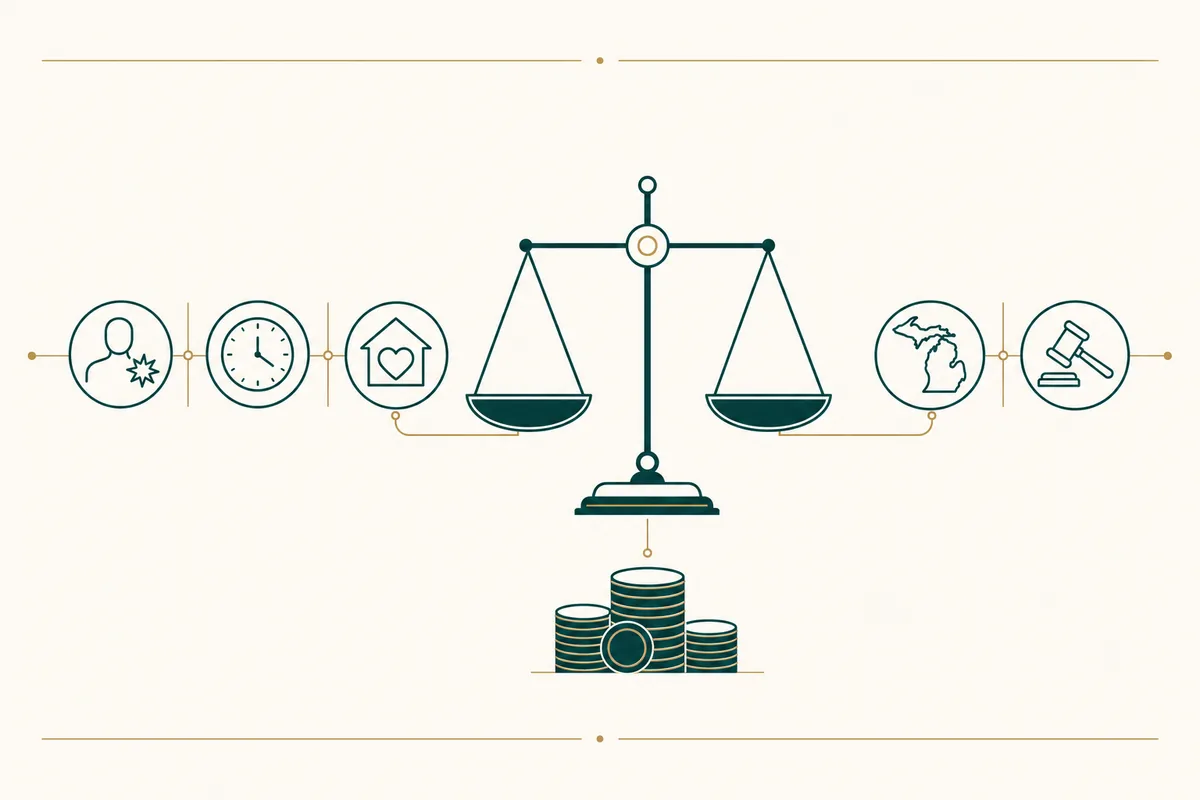
How Much Can You Sue for Emotional Distress in Michigan?
There is no statutory cap on non-economic damages — including emotional distress — in Michigan personal injury cases outside the medical malpractice context. (Medical malpractice cases are subject to inflation-adjusted two-tier caps under MCL § 600.1483.) For everything else — auto, premises liability, product liability, intentional torts — juries award what the evidence supports.
Realistic settlement ranges for emotional distress damages alongside a personal injury case in Michigan:
- Minor short-term anxiety or stress, no treatment: $1,000-$10,000.
- Documented anxiety or depression with brief treatment, full recovery: $10,000-$50,000.
- Diagnosed PTSD with sustained treatment, partial recovery: $50,000-$250,000.
- Severe PTSD with permanent or near-permanent symptoms, ongoing treatment, significant life impact: $250,000-$1,000,000+.
- Catastrophic emotional injury combined with serious physical injury: Frequently part of a multi-million-dollar overall recovery. See our Michigan personal injury case value guide.
These are illustrative; every case turns on the specific facts, medical documentation quality, and the firm's willingness to take the case to trial.
How to Document Emotional Distress for Maximum Recovery
The cases that resolve at the top of their range share specific documentation patterns:
- Same-week mental health contact. A first appointment with a therapist or psychiatrist within days of the triggering incident is foundational. Cases where the first mental health visit is months later are dramatically harder.
- Consistent, ongoing treatment. Weekly or biweekly therapy sustained over months establishes that the distress is real and persistent. Defense scrutinizes treatment gaps.
- Formal DSM-5 diagnosis. PTSD, major depression, generalized anxiety disorder. The diagnosis must be in writing in the treating provider's records.
- Medication management. Where indicated, prescribed psychiatric medications (SSRIs for depression/anxiety, prazosin for PTSD nightmares) document medical necessity of treatment.
- Validated symptom scales. PCL-5 (PTSD Checklist), PHQ-9 (depression), GAD-7 (anxiety), administered repeatedly by the treating provider, produce numeric severity scores defense cannot easily dismiss.
- Symptom journal kept contemporaneously. Daily dated notes, ideally in a notebook that can be produced in discovery.
- Family and coworker testimony. People close to the plaintiff describing the difference between pre-incident and post-incident behavior. Most compelling when these witnesses have no financial stake.
- Vocational impact evidence. Lost work days, reduced productivity, missed promotions, eventual job loss — documented through employment records.
- Independent forensic evaluation in serious cases. A retained forensic psychiatrist or psychologist who reviews the entire file and produces a comprehensive evaluation report.
What Insurance Carriers Argue Against Emotional Distress Claims
Defense playbook is consistent across cases:
- "The distress isn't severe enough to be legally compensable." Defense compares the plaintiff's symptoms to severe published-case examples and argues they fall short. Counter: PCL-5 scores, GAF/WHODAS functional ratings, treating provider testimony on severity.
- "The distress is caused by something else — pre-existing condition, life stress, a different incident." Defense subpoenas every prior mental health record, every prior insurance claim, every previous accident. Counter: treating provider testimony establishing causal connection to the index incident; thorough chronology showing pre-injury baseline.
- "The plaintiff is exaggerating or malingering." Defense retains its own forensic psychiatrist who administers validity testing. Counter: the plaintiff's own validity scores typically pass; consistency of symptom presentation across multiple providers supports credibility.
- "Treatment was unnecessary." Defense argues some or all of the mental health treatment was not reasonably necessary. Counter: treating provider records, documented diagnosis, standard-of-care opinion from a qualified expert.
- "The Michigan threshold isn't met" (auto cases). Defense argues the impairment doesn't affect the plaintiff's general ability to lead a normal life. Counter: vocational records, family testimony, journal entries, treating-provider impairment ratings.
Frequently Asked Questions
Q: Can you sue for pain and suffering in Michigan? Yes. Pain and suffering damages — including emotional distress, mental anguish, loss of enjoyment of life, and loss of consortium — are recoverable in Michigan personal injury cases. For auto accidents, you must clear the MCL § 500.3135 serious-impairment-of-body-function threshold first. Outside the medical malpractice context, there is no statutory cap.
Q: How much can you sue for emotional distress in Michigan? Variable, generally tied to the severity and duration of the distress, the supporting medical documentation, and the underlying claim. Settlement ranges run from a few thousand dollars for minor short-term distress to high six figures or more for documented, permanent PTSD. Outside the medical malpractice context, Michigan does not cap non-economic damages.
Q: Can I sue for emotional distress without a physical injury? In Michigan, generally yes for IIED (where the conduct is extreme and outrageous), and in limited circumstances for NIED. For most run-of-the-mill negligence cases, however, emotional distress damages are recoverable only as part of a broader personal injury claim involving physical injury.
Q: How long do I have to sue for emotional distress in Michigan? Three years from the date of injury under MCL § 600.5805 for negligence-based claims (NIED, personal injury). Three years for IIED. Government-entity defendants require an additional 120-day written notice under MCL § 691.1404, separate from the three-year deadline.
Q: Can I sue my employer for emotional distress? Yes, in some circumstances. Workers' compensation under MCL § 418.131 is the exclusive remedy against your employer for work-related physical injuries, but extreme conduct that satisfies IIED (severe harassment, deliberate trauma exposure) may give rise to a separate claim. Whistleblower retaliation, Elliott-Larsen Civil Rights Act violations, and sexual harassment also create independent statutory claims.
Q: Can I counter-sue for emotional distress? If you're being sued and the plaintiff's conduct meets IIED or NIED requirements, yes — a counterclaim is procedurally available. Whether it succeeds turns on the same elements that govern an initial emotional distress claim.
Q: Can I sue a hospital for emotional distress? Yes — under medical malpractice if the distress arose from negligent medical care, or under premises liability if it arose from conditions on hospital property. Medical malpractice claims are subject to a two-year statute of limitations under MCL § 600.5838a, plus mandatory Notice of Intent and Affidavit of Merit procedural requirements, plus inflation-adjusted damages caps under MCL § 600.1483.
Q: Can I sue a car dealership for emotional distress? In limited circumstances. Standalone emotional distress claims against a dealership typically require IIED-level conduct (e.g., extreme deceptive practices combined with personal harassment). More commonly, emotional distress is recoverable as part of broader fraud, breach of contract, or Magnuson-Moss Warranty Act claims.
Q: What is the difference between emotional distress and pain and suffering? Pain and suffering is the umbrella category of non-economic damages. Emotional distress is one component (alongside physical pain, loss of enjoyment of life, scarring, loss of consortium, etc.). In litigation practice, "emotional distress damages" generally refers to the psychological-injury portion of the broader pain and suffering award.
Q: Do I need an attorney to sue for emotional distress? If the case has any complexity — medical documentation, expert testimony, threshold litigation, or substantial damages potential — yes. Pro-se emotional distress claims have a poor track record because the proof requirements (medical evidence, expert opinion, causation) require attorney development. Most Michigan personal injury attorneys, including Koussan Law, work on contingency — you pay nothing unless we recover.
Speak With a Michigan Emotional Distress Attorney
If you've suffered emotional distress following an accident, an intentional incident, or any other event caused by another party's conduct, contact our emotional distress lawyers at Koussan Law for a free, confidential consultation. We accept Michigan emotional distress and personal injury cases on contingency. You pay nothing unless we recover. We have offices in Detroit, Dearborn Heights, and Marquette, and we accept cases statewide. Call (313) 800-0000, request a consultation online, or use our free case calculator to estimate your claim.
Related Resources
- PTSD & Emotional Distress Claims
- General Personal Injury
- Auto Accidents
- Michigan No-Fault Attorney
- How Much Is My Michigan Personal Injury Case Worth?
- Michigan Personal Injury Statute of Limitations
Past results do not guarantee future outcomes. Every emotional distress case is fact-specific and depends on the underlying incident, the quality of the medical documentation, the applicable threshold and damages caps, and qualified expert review. Settlement ranges discussed are illustrative only. This article is for general informational purposes and is not legal advice. Reading this article does not create an attorney-client relationship with Koussan Law.
If you are looking for an emotional distress lawyer in Michigan, our PTSD and emotional distress team evaluates claims at no cost.