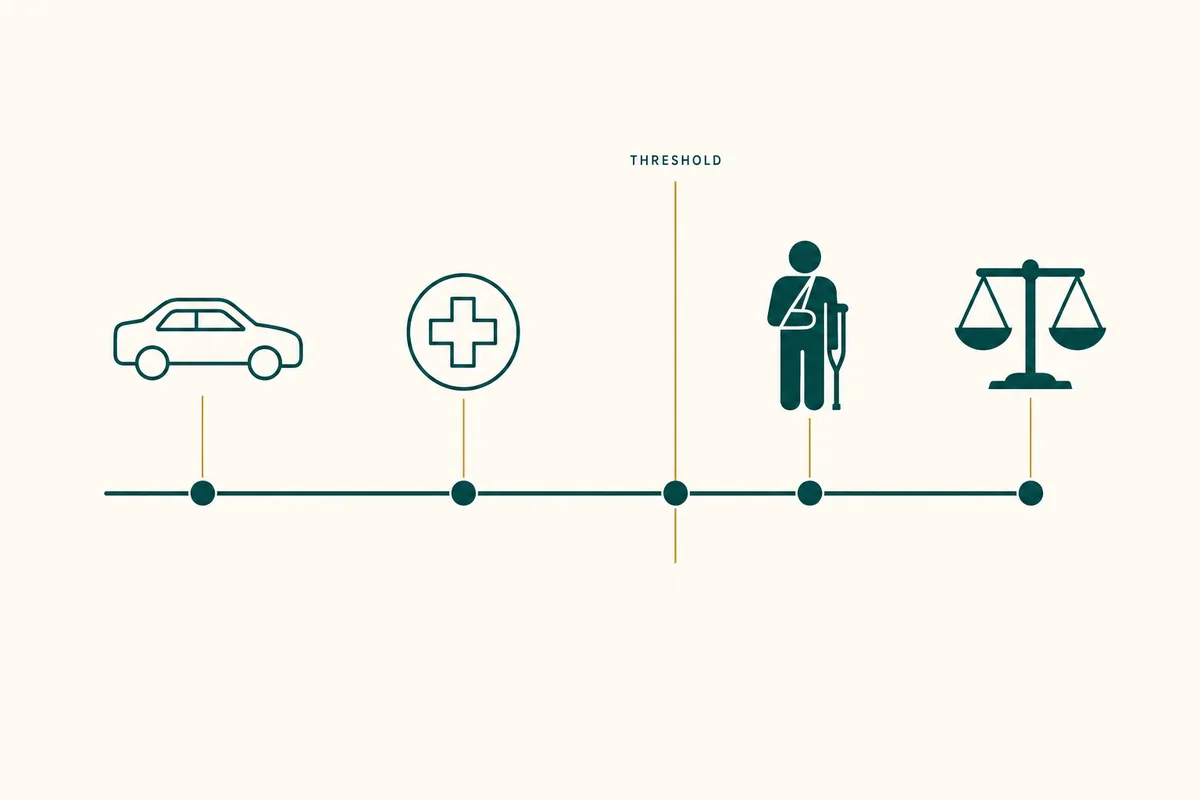
Short answer: Back pain after a Michigan crash runs through two separate claims, and only one of them has a hurdle. Your own no-fault PIP insurer pays for the treatment and the time you miss from work no matter who caused the crash. To also recover pain and suffering from the at-fault driver, you have to clear the serious impairment threshold in MCL 500.3135. That statute asks whether your impairment is objectively manifested, not whether an MRI shows something dramatic. The difference between those two questions is why a back claim an adjuster calls weak can still be a real case.
Two claims, and people mix them up constantly
The call we get most often is the same: someone was rear-ended three weeks ago, their lower back has not loosened up, and an adjuster has told them it is not worth much. Usually they are describing one claim when the law gives them two.
The first is the no-fault claim against your own insurer under MCL 500.3107. It pays reasonable and necessary medical treatment, plus work loss if the injury keeps you off the job, without regard to fault and with no threshold to clear. If your back hurts and a doctor is treating it, that claim exists on day one.
The second is the claim against the driver who hit you, for pain, suffering and the way the injury has changed your life. That one has the threshold, and that is what the degeneration fight is really about. Mixing the two costs people money: they hear "threshold," stop treating, and end up with no record to prove the case with. More on the first claim is on our Michigan no-fault PIP claims page.
The insurer's first move is to call it degeneration
Order an MRI of the lumbar spine of almost any adult over thirty and it will show something: disc desiccation, bulging, facet arthropathy, degenerative changes. That is ordinary, and it is also the whole defense playbook in a back case.
The radiology report uses the word "degenerative," a reviewer the insurer hired writes that the findings are chronic and age related, and the adjuster's position becomes that the crash did nothing. It is a strong-sounding argument made to someone who has never read the statute, and it is narrower than it looks, for two reasons that sit in Michigan law rather than in medicine.
What the threshold statute actually asks
Under MCL 500.3135(1), a person stays subject to tort liability for noneconomic loss from the use of a motor vehicle "only if the injured person has suffered death, serious impairment of body function, or permanent serious disfigurement." Subsection (5) defines serious impairment of body function as "an objectively manifested impairment of an important body function that affects the person's general ability to lead his or her normal life." Pre-2019 opinions cite that same definition at subsection (7), so an older case quoting (7) is only renumbered, not outdated.
In McCormick v Carrier, 487 Mich 180; 795 NW2d 517 (2010), the Michigan Supreme Court broke that sentence into three prongs: "(1) an objectively manifested impairment (2) of an important body function that (3) affects the person's general ability to lead his or her normal life."
Now read the first prong again. The statute does not say objectively manifested injury. McCormick made the point explicitly: the statute "does not contain the word 'injury,' and, under the plain language of the statute, the proper inquiry is whether the impairment is objectively manifested, not the injury or its symptoms."
That is the sentence the degeneration argument walks into. How the disc looked before the crash goes to the injury. The threshold asks about the impairment, which is what the back will no longer do.
A normal MRI does not end a Michigan back claim
McCormick defined "objectively manifested" in ordinary language: an impairment "evidenced by actual symptoms or conditions that someone other than the injured person would observe or perceive as impairing a body function," that is, one "observable or perceivable from actual symptoms or conditions."
Imaging is one way to show that. It is not the only way. A positive straight-leg raise, measured loss of range of motion, spasm a doctor can feel, an antalgic gait, diminished reflexes, measured strength loss in a leg: those are conditions another person observes. Michigan law has long required a plaintiff to "introduce evidence establishing that there is a physical basis for their subjective complaints of pain and suffering," with medical testimony generally needed to show an impairment. McCormick went out of its way to disapprove any reading of the earlier Kreiner decision that would make medical documentation mandatory in every case.
So the honest answer to "my MRI was normal, is my case over" is no, not on that fact alone. What ends a back claim is an absence of anything observable, which is usually a treatment-record problem.
Pre-existing degeneration is not the defense the adjuster thinks it is
Michigan law takes an injured person as it finds them. In Wilkinson v Lee, 463 Mich 388; 617 NW2d 305 (2000), the Supreme Court put the rule plainly: "Regardless of the preexisting condition, recovery is allowed if the trauma caused by the accident triggered symptoms from that condition."
That reframes the fight. The question is not whether you had degenerative changes before the crash, because most people your age do. It is whether you were working, sleeping and getting through a day before the crash, and whether you can now. A spine that degenerated quietly for ten years and became symptomatic the week a truck hit you is the ordinary shape of an aggravation claim, not a defense to one.
The degeneration argument often creates the fact question
There is a procedural turn worth knowing, because it is where these cases are won and lost.
Under MCL 500.3135(2)(a), whether a serious impairment occurred is a question of law for the judge only if there is no factual dispute about the nature and extent of the injuries, or the dispute is not material to the threshold. In Patrick v Turkelson, 322 Mich App 595; 913 NW2d 369 (2018), the Court of Appeals reversed a trial court that had dismissed a claim on the threshold, holding that where there is a genuine issue of material fact about the nature and extent of the impairment, the question belongs to the jury and may not be decided as a matter of law.
Now consider what the insurer has done when its reviewer calls the findings degenerative and your treating physician says the crash made a quiet condition symptomatic. That is a dispute about the nature and extent of the injury, and it is plainly material. The argument meant to end the case is often the thing that proves it cannot be ended on a motion.
What the medical record has to show
Cases are built out of records, and most of the damage is done in the first sixty days without anyone meaning to. If your back hurts after a Michigan crash:
- Report the back specifically at the first visit, and make sure it is written down. Emergency rooms triage for emergencies, and a record saying only "neck pain" because the back hurt less that night is the most common hole in these files.
- Describe function, not just pain. "I cannot sit for more than twenty minutes" is something someone else can test. A pain score out of ten is not.
- Go to the appointments. Gaps are read as recovery, fairly or not, and a six-week gap will be the first exhibit at your deposition.
- Get prior imaging pulled. If you had a lumbar MRI two years ago, the comparison helps you more often than the insurer expects: it shows what was already there and causing no trouble.
- Ask for written restrictions. A note putting a weight or sitting limit in writing turns your complaint into a clinical finding.
- Tell your doctor what you have stopped doing. The third prong is about your normal life, and nobody reconstructs that from imaging.
The deadlines that quietly cost people money
Two clocks run from the date of the crash, and they are not the same.
For no-fault benefits, MCL 500.3145 requires written notice of injury to the insurer within one year of the accident, and carries the one-year-back rule: you cannot recover benefits for expenses incurred more than a year before suit is filed. Someone who treats quietly for two years and then sues loses the older bills even with a good claim.
For the claim against the at-fault driver, the personal injury limitations period in MCL 600.5805 is three years from the crash. Back injuries are exactly the kind that tempt people to wait, because the first months look like they might resolve on their own.
Questions we get about back pain claims in Michigan
My back only started hurting a few days after the crash. Does that hurt my claim? It is common and explainable, but tell a doctor as soon as it happens. Delayed onset in the lumbar spine is well recognized. The problem is not the delay, it is a two-month silence in the chart followed by a complaint that first appears after someone hires a lawyer.
The adjuster says my MRI shows degenerative disc disease, so the crash did not cause anything. Is that right? No, that conflates two questions. Michigan asks whether the impairment is objectively manifested, and under Wilkinson v Lee recovery is allowed where the trauma triggered symptoms from a pre-existing condition. Degeneration in the images is where the argument starts, not where it ends.
Does a herniated disc automatically clear the threshold? No. No diagnosis automatically clears it and none automatically fails it. The test runs on the impairment and how it has changed your normal life, which is why two people with identical imaging can have very different claims.
Will my own insurance pay for treatment while this is argued? That is what PIP is for, and it does not wait on the fault fight. If your insurer is denying or delaying reasonable and necessary treatment, that is its own claim with its own remedies.
Talk to a Michigan back and spine injury lawyer
A free consultation on a back injury is mostly about three things: whether your treatment record captures function or only pain, whether the degeneration argument in your file has anything behind it, and which of the two clocks above is closest to running out. All three are cheaper to fix early than late. If you are still working out whether you have a claim against the other driver at all, our explainer on the threshold that decides whether you can sue answers that one.
Call Koussan Law at (313) 800-0000 or request a free consultation. We handle car accident and back, spinal and disc injury claims across Michigan, with offices in Detroit, Dearborn Heights and Marquette. We speak English, Spanish and Arabic.
Important: This is not legal advice
This article is general information about Michigan personal injury law. It is not legal advice and should not be relied on as a substitute for consultation with a licensed Michigan attorney about your specific situation. The laws, deadlines, procedures, and frameworks here are general guidelines that may or may not apply to your case.
Every personal injury case turns on its own unique facts. The timing, the parties, the evidence, the jurisdiction, the insurance available, and dozens of other variables can change the legal analysis. Do not rely on anything written on this website to make decisions about your case.
If you have been injured in Michigan, the only responsible step is to speak with a licensed Michigan attorney about your specific facts. Call Koussan Law at (313) 800-0000 for a free consultation, or contact a different Michigan personal injury attorney of your choosing.
Reading this article does not create an attorney-client relationship with Koussan Law. Past results do not guarantee future outcomes.