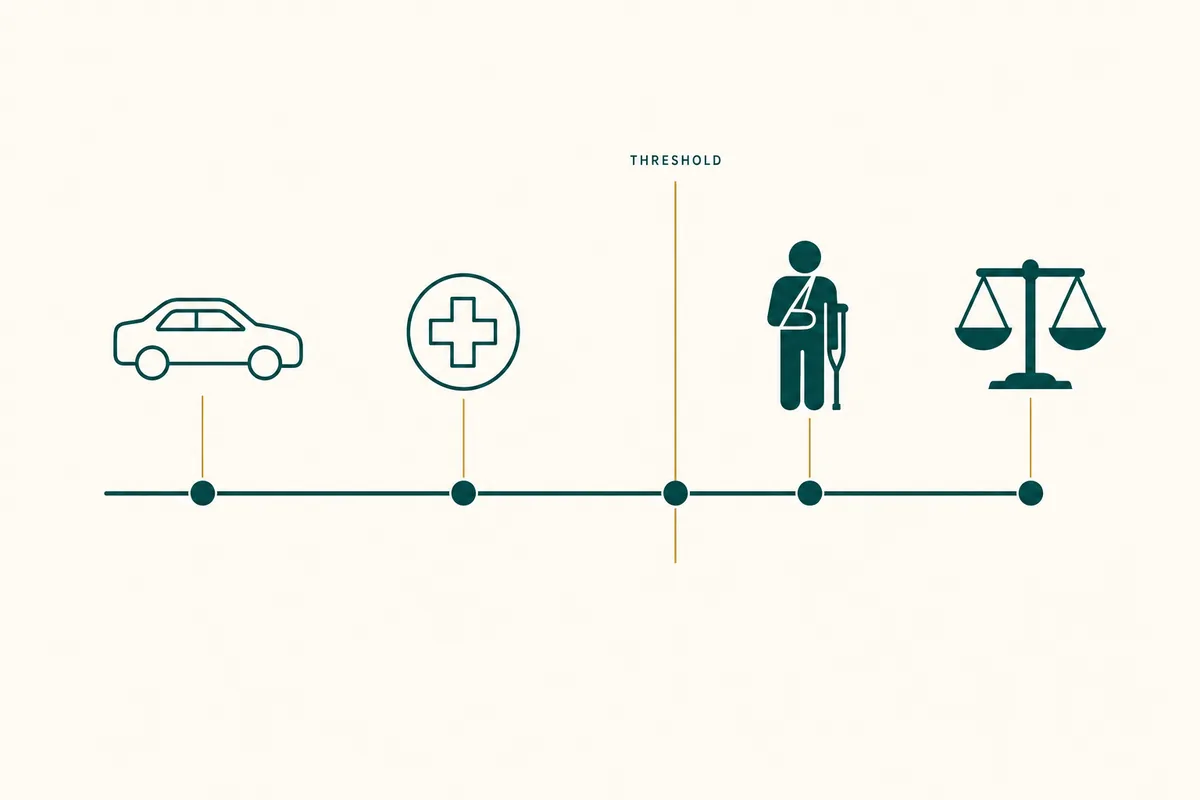
Short answer: yes, you can sue the at-fault driver in Michigan, but only for certain things. Michigan is a no-fault state, so the law abolishes most tort liability between drivers and then writes a few exceptions back in. To recover pain and suffering, you have to clear what lawyers call the threshold: death, permanent serious disfigurement, or serious impairment of body function (MCL 500.3135). Two other claims, the mini-tort for vehicle damage and a claim for economic losses beyond what no-fault pays, need no threshold at all. Nearly every contested Michigan injury case turns on that middle phrase, and it is won or lost on proof of how the injury changed what you can do, not on the injury itself.
What the statute actually says
Michigan drivers are not generally liable to each other for causing a crash. The no-fault act took that liability away and replaced it with benefits your own insurer pays regardless of fault. Our guide to Michigan no-fault benefits covers what those benefits are.
What survives is a short list of exceptions. A driver remains subject to tort liability for noneconomic loss, the legal name for pain, suffering and the loss of the life you had, only if the injured person "has suffered death, serious impairment of body function, or permanent serious disfigurement." Those three are the threshold injuries. Death and permanent serious disfigurement are usually obvious on the facts. Serious impairment of body function is where the argument lives, and it is the reason two people with the same MRI can get very different answers about their case.
The three-part test that decides your case
The statute defines a serious impairment of body function in three parts. The impairment must be objectively manifested, which the statute defines as observable or perceivable from actual symptoms or conditions by someone other than the injured person. It must involve an important body function. And it must affect the person's general ability to lead their normal life.
Those three prongs come from McCormick v Carrier, 487 Mich 180 (2010), where the Michigan Supreme Court overruled an earlier decision that had made the threshold far harder to meet. The Court read the statute to require "(1) an objectively manifested impairment (observable or perceivable from actual symptoms or conditions) (2) of an important body function (a body function of value, significance, or consequence to the injured person) that (3) affects the person's general ability to lead his or her normal life." When the Legislature rewrote the no-fault act in 2019, it stated in the enacting language that it "intended to codify and give full effect to" McCormick. The 2010 case and the current statute say the same thing.
Two features of that test matter more than most people expect. Nothing in it requires a permanent injury. And nothing requires that your entire life be ruined. The question is whether the impairment influences some of your capacity to live in your normal manner of living. A broken ankle that kept a man off the job for nineteen months met the threshold in McCormick even though he returned to work at the same pay and was fishing again within months.
Where these cases are actually lost
Here is the distinction that ends more Michigan threshold cases than any other. An MRI proves an injury. The threshold asks about an impairment. Those are different words, they mean different things, and the courts enforce the difference.
McCormick said it directly: the statute does not contain the word "injury," so the question is whether the impairment is objectively manifested, not whether the injury is. An injury is the damage itself. An impairment is the effect of that damage on a body function. Imaging that documents a disc bulge tells a court that something is wrong with your spine. It does not tell the court what you can no longer do.
In an unpublished February 2026 decision, Jones v Hammons (Docket No. 374665), the Court of Appeals affirmed the dismissal of a claim brought by a woman rear-ended by a semi-truck. She pointed to imaging showing a disc bulge and spinal stenosis. Unpublished decisions do not bind other courts, but the panel's reasoning is the standard analysis: the records documented the existence of an injury, no family member or coworker testified about limitations they could observe, and a list of diagnoses with no objective findings behind them was not evidence of an impairment. One of her own records stated there was no electrodiagnostic evidence of the radiculopathy that appeared on her diagnosis list.
Compare Patrick v Turkelson, 322 Mich App 595 (2018), a published decision that came out the other way. The plaintiff alleged ringing in her ears after an airbag deployed, which sounds like the most subjective complaint imaginable. Her case survived because her doctors explained how testing produced objective results, and her husband testified that after the crash she spoke too softly or too loudly for him to understand her. Same statute, opposite result. The difference was evidence of the effect on function.
What proof of an impairment looks like
- Get treated, then get the functional findings. A diagnosis is the starting point, not the finish. Range-of-motion measurements, strength testing, a functional capacity evaluation and work restrictions are the records that describe an impairment.
- Ask your doctor to describe function, not just anatomy. "Disc herniation at L5-S1" is anatomy. "Cannot lift more than ten pounds, cannot stand more than twenty minutes" is function, and function is what the statute asks about.
- Line up the people who see you daily. A spouse, an adult child, a supervisor or a coworker who can describe what you stopped doing is often worth more than another scan. The statute's own words ask what someone other than you can observe.
- Write down what your normal life looked like before. Hours worked, the second job, the yard, the deer camp, coaching, lifting your grandchild. The comparison is to your life, not to an average person's.
- Keep the treatment timeline clean. Long unexplained gaps get argued as proof that you recovered. If you stopped care because you could not afford it or could not get a ride, say so in the record at the time.
- Be careful with recorded statements and social media. "I'm doing fine" is a courtesy in conversation and a quote in a summary disposition brief. One photograph of a good day gets used to answer a year of bad ones.
Two claims that do not need the threshold
This is the part most articles skip, and it costs people money.
The mini-tort. Michigan's mini-tort allows recovery of up to $3,000 from the at-fault driver for damage to your vehicle (MCL 500.3135). It is a vehicle damage claim, not an injury claim, and it exists whether or not anyone was hurt. It is usually how a deductible gets paid back.
Excess economic loss. The no-fault act also lets you sue the at-fault driver for economic losses that exceed the benefits no-fault pays. No threshold showing is required for that claim. The Michigan Supreme Court settled the point in Ouellette v Kenealy, 424 Mich 83 (1985), and the Court of Appeals repeated it this year. It matters because no-fault wage loss runs for only three years and is subject to a monthly maximum set by the state. If you earn more than that maximum, or you are still unable to work after three years, the shortfall is an economic loss the at-fault driver can be liable for even if your injury never clears the threshold for pain and suffering.
The deadlines that end good claims
A claim against the at-fault driver for injuries generally must be filed within three years of the crash (MCL 600.5805). That is a separate clock from your no-fault benefits, which require written notice to your insurer within one year of the crash and limit recovery to expenses incurred in the year before suit is filed (MCL 500.3145). People lose benefits while their injury claim is still perfectly alive, because they assumed one deadline covered everything.
If a government vehicle or a government employee was involved, the deadlines are shorter and the notice requirements are strict. Those cases need attention in weeks, not years.
Frequently asked questions
Do I have to be permanently injured to sue in Michigan? No. The statute has no permanency requirement, and McCormick expressly rejected reading one in. A serious but temporary impairment can meet the threshold, and a permanent condition that changes nothing about your daily life may not.
Who decides whether I meet the threshold, a judge or a jury? The judge decides it as a matter of law when there is no material factual dispute about the nature and extent of your injuries. When the parties genuinely dispute those facts, it goes to the jury. This is why insurers fight so hard over whether a dispute is "material."
My doctor says I'm injured but I went back to work. Is my case over? Not necessarily. Returning to work cuts against you on the third prong, but it is not decisive. The plaintiff in McCormick returned to work and still met the threshold. What matters is the whole picture of what changed.
What if I was partly at fault? You can still recover economic damages, and comparative fault reduces what you collect. If you are found more than 50 percent at fault, you cannot recover noneconomic damages at all.
Does any of this apply if I was a passenger, a pedestrian or on a bike? The threshold works the same way for anyone suing a negligent driver. Which insurer pays your no-fault benefits is a separate question with its own priority rules, and it can get complicated fast, as our post on driving someone else's uninsured car shows.
Talk to a Michigan car accident lawyer
A free consultation on a threshold question is worth twenty minutes of your time. We will tell you honestly whether the records you have describe an impairment or only an injury, what proof is missing while it can still be created, whether you have a mini-tort or excess economic loss claim regardless of the threshold, and which deadline is closest. Our Michigan car accident lawyers litigate this issue constantly, and you can see the kinds of cases we have resolved on our results page. Call Koussan Law at (313) 800-0000 or request a free consultation. Offices in Detroit, Dearborn Heights and Marquette; we serve clients across Michigan in English, Spanish and Arabic.
Important: This is not legal advice
This article is general information about Michigan personal injury law. It is not legal advice and should not be relied on as a substitute for consultation with a licensed Michigan attorney about your specific situation. The laws, deadlines, procedures, and frameworks here are general guidelines that may or may not apply to your case.
Every personal injury case turns on its own unique facts. The timing, the parties, the evidence, the jurisdiction, the insurance available, and dozens of other variables can change the legal analysis. Do not rely on anything written on this website to make decisions about your case.
If you have been injured in Michigan, the only responsible step is to speak with a licensed Michigan attorney about your specific facts. Call Koussan Law at (313) 800-0000 for a free consultation, or contact a different Michigan personal injury attorney of your choosing.
Reading this article does not create an attorney-client relationship with Koussan Law. Past results do not guarantee future outcomes.