Michigan No-Fault Law, section by section › MCL 500.3135
Tort liability for noneconomic loss; exceptions; cause of action for damages; "serious impairment of body function" defined.
In plain terms
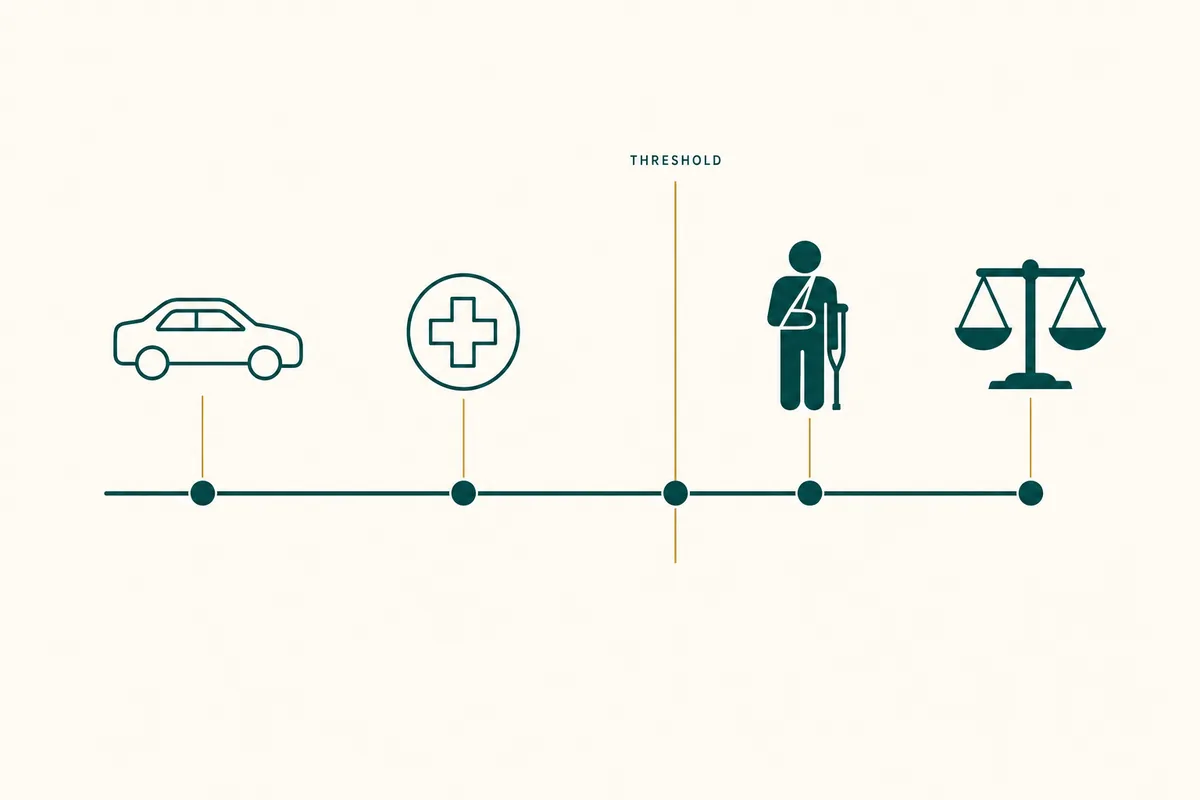
The centerpiece of Michigan auto injury litigation. A negligent driver is liable for noneconomic loss (pain and suffering) only if the injured person suffered death, serious impairment of body function or permanent serious disfigurement, and subsection (5) defines serious impairment: objectively manifested, an important body function, and an effect on the person's general ability to lead a normal life. Damages are reduced by comparative fault and barred entirely for a party more than 50% at fault or driving their own uninsured vehicle. Tort liability is otherwise abolished except for intentional harm, excess economic loss above PIP limits, economic loss of nonresidents, and the mini tort, which is up to $3,000 in vehicle damage for accidents after July 1, 2020.
How this section works in practice
Section 3135 is where a Michigan car crash becomes a lawsuit. Because PIP pays the economic losses, the act abolishes most tort liability between insured drivers and preserves only the pieces listed in subsection (3). The most important is noneconomic loss (pain, suffering, loss of enjoyment of life), which can be recovered only if the injured person suffered death, serious impairment of body function or permanent serious disfigurement.
Subsection (5) defines serious impairment with the three-part test the Supreme Court adopted in McCormick v Carrier and the legislature wrote into the statute in 2019: the impairment must be objectively manifested (observable by someone other than the injured person), it must affect an important body function, and it must affect the person's general ability to lead his or her normal life. There is no minimum duration; a temporary impairment can qualify, and the comparison is between the person's life before and after the crash. Whether the threshold is met is a question for the judge when the facts about the injury are not in dispute, with a special jury rule for closed-head injuries supported by a qualified physician.
Damages are reduced by the injured person's percentage of fault and are barred entirely for anyone more than 50% at fault or driving their own uninsured vehicle. Subsection (3)(c) preserves claims for economic losses above PIP limits, which is now the largest exposure for at-fault drivers, and subsection (3)(e) is the mini tort: up to $3,000 for vehicle damage not covered by insurance, brought in small claims court.
Text of MCL 500.3135
Sec. 3135.
(1) A person remains subject to tort liability for noneconomic loss caused by his or her ownership, maintenance, or use of a motor vehicle only if the injured person has suffered death, serious impairment of body function, or permanent serious disfigurement.
(2) For a cause of action for damages under subsection (1) or (3)(d), all of the following apply:
(a) The issues of whether the injured person has suffered serious impairment of body function or permanent serious disfigurement are questions of law for the court if the court finds either of the following:
(i) There is no factual dispute concerning the nature and extent of the person's injuries.
(ii) There is a factual dispute concerning the nature and extent of the person's injuries, but the dispute is not material to the determination whether the person has suffered a serious impairment of body function or permanent serious disfigurement. However, for a closed-head injury, a question of fact for the jury is created if a licensed allopathic or osteopathic physician who regularly diagnoses or treats closed-head injuries testifies under oath that there may be a serious neurological injury.
(b) Damages must be assessed on the basis of comparative fault, except that damages must not be assessed in favor of a party who is more than 50% at fault.
(c) Damages must not be assessed in favor of a party who was operating his or her own vehicle at the time the injury occurred and did not have in effect for that motor vehicle the security required by section 3101(1) at the time the injury occurred.
(3) Notwithstanding any other provision of law, tort liability arising from the ownership, maintenance, or use within this state of a motor vehicle with respect to which the security required by section 3101(1) was in effect is abolished except as to:
(a) Intentionally caused harm to persons or property. Even though a person knows that harm to persons or property is substantially certain to be caused by his or her act or omission, the person does not cause or suffer that harm intentionally if he or she acts or refrains from acting for the purpose of averting injury to any person, including himself or herself, or for the purpose of averting damage to tangible property.
(b) Damages for noneconomic loss as provided and limited in subsections (1) and (2).
(c) Damages for allowable expenses, work loss, and survivor's loss as defined in sections 3107 to 3110, including all future allowable expenses and work loss, in excess of any applicable limit under section 3107c or the daily, monthly, and 3-year limitations contained in those sections, or without limit for allowable expenses if an election to not maintain that coverage was made under section 3107d or if an exclusion under section 3109a(2) applies. The party liable for damages is entitled to an exemption reducing his or her liability by the amount of taxes that would have been payable on account of income the injured person would have received if he or she had not been injured.
(d) Damages for economic loss by a nonresident. However, to recover under this subdivision, the nonresident must have suffered death, serious impairment of body function, or permanent serious disfigurement.
(e) Damages up to $1,000.00 to a motor vehicle or, for motor vehicle accidents that occur after July 1, 2020, up to $3,000.00 to a motor vehicle, to the extent that the damages are not covered by insurance. An action for damages under this subdivision must be conducted as provided in subsection (4).
(4) All of the following apply to an action for damages under subsection (3)(e):
(a) Damages must be assessed on the basis of comparative fault, except that damages must not be assessed in favor of a party who is more than 50% at fault.
(b) Liability is not a component of residual liability, as prescribed in section 3131, for which maintenance of security is required by this act.
(c) The action must be commenced, whenever legally possible, in the small claims division of the district court or the municipal court. If the defendant or plaintiff removes the action to a higher court and does not prevail, the judge may assess costs.
(d) A decision of the court is not res judicata in any proceeding to determine any other liability arising from the same circumstances that gave rise to the action.
(e) Damages must not be assessed if the damaged motor vehicle was being operated at the time of the damage without the security required by section 3101(1).
(5) As used in this section, "serious impairment of body function" means an impairment that satisfies all of the following requirements:
(a) It is objectively manifested, meaning it is observable or perceivable from actual symptoms or conditions by someone other than the injured person.
(b) It is an impairment of an important body function, which is a body function of great value, significance, or consequence to the injured person.
(c) It affects the injured person's general ability to lead his or her normal life, meaning it has had an influence on some of the person's capacity to live in his or her normal manner of living. Although temporal considerations may be relevant, there is no temporal requirement for how long an impairment must last. This examination is inherently fact and circumstance specific to each injured person, must be conducted on a case-by-case basis, and requires comparison of the injured person's life before and after the incident.
History: Add. 1972, Act 294, Eff. Mar. 30, 1973 ;-- Am. 1979, Act 145, Imd. Eff. Nov. 13, 1979 ;-- Am. 1979, Act 147, Imd. Eff. Nov. 13, 1979 ;-- Am. 1995, Act 222, Eff. Mar. 28, 1996 ;-- Am. 2002, Act 697, Eff. Mar. 31, 2003 ;-- Am. 2012, Act 158, Eff. Oct. 1, 2012 ;-- Am. 2019, Act 21, Imd. Eff. June 11, 2019 ;-- Am. 2019, Act 22, Imd. Eff. June 11, 2019
Source: MCL 500.3135 at legislature.mi.gov (official text). Text as published in the 2025 Michigan Compiled Laws; reviewed by Koussan Law on September 15, 2026.
Sections this one refers to
- MCL 500.3101: Who Must Carry No-Fault Insurance
- MCL 500.3107: What PIP Pays: Medical, Wage Loss, Services
- MCL 500.3110: Dependents and When Benefits Accrue
- MCL 500.3107c: Choosing a PIP Medical Coverage Level
- MCL 500.3107d: Opting Out of PIP Medical With Medicare
- MCL 500.3109a: Coordinated PIP and Health Insurance
- MCL 500.3131: Residual Liability Insurance
Sections that refer to this one
- MCL 500.3116: PIP and Tort Recoveries
- MCL 500.3131: Residual Liability Insurance
- MCL 500.3136: Property Damage Above the PPI Limit
Practice pages
Important: This is not legal advice
This article is general information about Michigan personal injury law. It is not legal advice and should not be relied on as a substitute for consultation with a licensed Michigan attorney about your specific situation. The laws, deadlines, procedures, and frameworks here are general guidelines that may or may not apply to your case.
Every personal injury case turns on its own unique facts. The timing, the parties, the evidence, the jurisdiction, the insurance available, and dozens of other variables can change the legal analysis. Do not rely on anything written on this website to make decisions about your case.
If you have been injured in Michigan, the only responsible step is to speak with a licensed Michigan attorney about your specific facts. Call Koussan Law at (313) 800-0000 for a free consultation, or contact a different Michigan personal injury attorney of your choosing.
Reading this article does not create an attorney-client relationship with Koussan Law. Past results do not guarantee future outcomes.