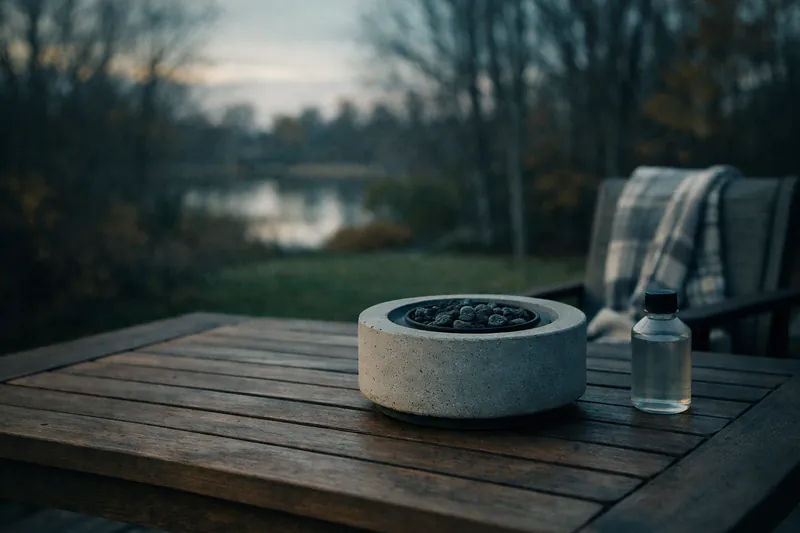
Short answer: The small concrete, ceramic and metal bowls sold as tabletop fire pits, fire pots and mini fireplaces are on a lot of gift lists this season. The ones that burn rubbing alcohol or bioethanol poured straight into the bowl are the ones the U.S. Consumer Product Safety Commission has told the public to stop using. The agency's instruction, in force since December 19, 2024, is one sentence: "Consumers should immediately stop using and dispose of these products. Sellers should stop selling these products." Before you buy one, check how it is fueled. If you already own one, the CPSC's advice is to get rid of it. And if one of these products has already flame-jetted or exploded and burned someone in your family in Michigan, keep the fire pit and the fuel bottle, get the burn treated, and read our guide to tabletop fire pit burn claims in Michigan.
If that already happened to you, call (313) 800-0000 or use the form on this page. The consultation is free.
What the CPSC has said, in its own words
The December 19, 2024 consumer alert is not a recall of one brand. It covers a whole type of product. The CPSC describes it this way: "Fire pits that require consumers to pour isopropyl (rubbing) alcohol or other liquid fuel into an open container or bowl and then ignite the pooled liquid in the same location it was poured violate the requirements in voluntary safety standard ASTM F3363-19." The agency adds that "These products are also sold as tabletop fire pits, fire pots, miniature fireplaces, or portable fires for indoor use."
The reason for the alert is in two sentences. "These fire pits are extremely dangerous and have been associated with two deaths and at least 60 injuries since 2019." And: "Isopropyl (rubbing) alcohol, ethanol/bioethanol, and similar liquid fuels burn with flame temperatures over 1,600°F and can cause third degree burns in less than one second."
The injuries happen in two ways. The first is a pool fire in the open bowl. The second is the one that hurts people sitting across the table: "Flame jetting, a second hazard, can occur when refilling alcohol or other liquid-burning fire pits if any flame is present. A small flame in the fire pit can be hard to see and can ignite alcohol or other liquid fuel as it is poured, causing an explosion that propels flames and burning liquid onto the consumer or bystanders."
Health Canada reached the same conclusion about one of the brands on January 7, 2025, and its description is useful because it is plain: these are "small, decorative bowls or open containers that require consumers to pour isopropyl (rubbing) alcohol into the bowl and then ignite the pooled alcohol in the same location it was poured." Its warning: "A flame in a FLIKRFIRE tabletop fireplace can be hard to see and the vapours inside the fuel container can ignite as it is poured into the fireplace." Health Canada told owners to "immediately stop using them and safely dispose of the items in such a way that they cannot be used again."
The CPSC has also published brand-specific recalls and warnings, one before the category alert, one on the same day and the rest after it, several of them because the seller did not agree to a recall. In date order: Colsen fire pits, recall 25-015 (October 17, 2024); FLIKRFIRE tabletop fireplaces, warning 25-073 (December 19, 2024); Five Below tabletop fire pits, recall 25-467 (September 18, 2025); Rozato tabletop fire pits, warning 26-364 (April 2, 2026); Northlight bio ethanol tabletop fireplaces, warning 26-473 (May 7, 2026); Houswise tabletop fire pits, warning 26-615 (July 16, 2026); Brookstone-branded tabletop fire pits, recall 26-687 (August 13, 2026). Each notice carries the agency's own counts and remedy; our landing page sets them out in a table. A product that is not on that list is not safe by omission. The December 2024 alert covers every open-bowl alcohol fire pit by design, whatever the brand.
How to recognize one in a listing or on a shelf
The CPSC's definition is the test. Ask these questions before you buy, and before you light a gift you were given:
- How is it fueled? If the instructions say to pour rubbing alcohol, isopropyl alcohol, bioethanol or "fireplace fuel" into the bowl and light it there, it is the type the CPSC described. The fuel is often sold separately, in a squeeze bottle, sometimes as a bundle with the pit.
- Is there an open reservoir? A shallow concrete, ceramic or metal bowl, or a cup set into a bowl, with nothing between the pooled fuel and the flame, is the design in the alert. The alert's words are "an open container or bowl."
- How is it described? The CPSC says these products "are also sold as tabletop fire pits, fire pots, miniature fireplaces, or portable fires for indoor use." Marketing words like "smokeless," "indoor-safe" or "clean-burning" describe the fuel's smoke, not the flame-jetting risk.
- How much does it cost? The recall and warning notices describe units that sold online and in discount stores for a few dollars to under a hundred. A low price and an unfamiliar brand name sold through a marketplace storefront are common to most of the notices.
If the answers add up to an open-bowl alcohol fire pit, the CPSC's position is the one quoted above: stop using, dispose, and sellers should stop selling. The agency has named the voluntary standard these products violate, ASTM F3363, but it has not named a compliant product, and neither do we.
If you already own one, or one is on your list
The CPSC's advice to an owner who has not been hurt is to stop using the unit and dispose of it. Health Canada adds that it should be disposed of "in such a way that they cannot be used again," which means not passing it on, not donating it and not listing it for resale. Where a recall offers a remedy, as the Five Below and Brookstone-branded notices did, the notice explains how to claim it. If you had an incident with one of these products, whether or not anyone was hurt, the CPSC asks you to report it: "Report a dangerous product or a product-related injury on www.SaferProducts.gov." Those reports are part of how the agency learns which products to name.
If you were planning to give one, the simplest course is to give something else. We are not in the business of recommending products, and this post does not. It passes along what two national safety agencies have said about one type of product that is heavily marketed in November and December.
If a tabletop fire pit already burned someone in your family
The injured person may have a product liability claim under Michigan law, whoever bought the fire pit and whoever was holding the fuel bottle. What matters in the first week:
- Get the burn treated, and keep the records. Burns to the face or hands, second- or third-degree burns, and any inhalation injury belong at a burn center. Photograph the burns at every stage, with dates.
- Keep the fire pit and the fuel bottle. Do not use them, do not clean them, do not throw them away. Store them sealed, cool and away from any flame, with the packaging and instructions if you have them. The CPSC tells uninjured owners to dispose of these units; when someone was hurt, the unit and the bottle are the evidence of what happened.
- Find the purchase record. The order history, receipt or card statement, or the gift-giver's order confirmation, names the seller, the model and the sale date. For a gift, ask the person who bought it for the order email; nobody is in trouble for buying a product that was sold as safe.
- Report it at SaferProducts.gov, briefly and factually.
- Know the clock. Michigan generally allows three years from the injury to file a product liability action under MCL 600.5805, subsection 12. Sellers, storefronts and online listings disappear much faster than that.
Who answers for the injury is worked out from the chain of sale: the manufacturer, the importer, the brand owner, the store or website that sold it, and the company that sold the fuel. Michigan's product liability statute, MCL 600.2945 and the sections that follow it, treats a store or website that did not make the product differently from the manufacturer: under MCL 600.2947, subsection 6, a seller that did not manufacture the product answers for its own failure to use reasonable care, and under MCL 600.2948, subsection 4, for what it did after it learned of the danger. The full discussion, including the deadline rules and the misuse defense, is on our landing page.
Common questions
Is it safe to give a tabletop fire pit as a gift? That depends on how it is fueled. For the type that burns rubbing alcohol or other liquid fuel poured into an open bowl, the CPSC's answer has been the same since December 2024: "Consumers should immediately stop using and dispose of these products." The agency has not named a compliant alternative, and this post does not recommend one.
How can I tell whether a tabletop fire pit uses alcohol? Read the fuel instructions. If the product is fueled by pouring isopropyl (rubbing) alcohol, bioethanol or "fireplace fuel" into the bowl and lighting it there, it is the design the CPSC described. The fuel is often sold separately in a squeeze bottle.
The one I bought is not on any recall list. Does that mean it is safe? No. The December 19, 2024 alert covers every fire pit of this design, whatever the brand, and the CPSC has published six brand-specific notices from that day on, four of them in 2026. A product's absence from the list means only that the agency has not published a notice about it.
I gave the fire pit as a gift and it burned the person I gave it to. Am I responsible? Michigan's product liability statutes are about the companies that made and sold the product, not the friend or relative who bought it as a gift. The injured person's claim runs against the chain of sale. What helps most is your order confirmation, which identifies the seller, the model and the sale date.
How long does the injured person have to file in Michigan? Generally three years from the injury under MCL 600.5805, subsection 12. If the injured person has died, the wrongful death rules can give the estate's personal representative a limited extension. Evidence, sellers and listings disappear faster than the deadline, so the clock is not the reason to wait.
Talk to a Michigan burn injury lawyer about a tabletop fire pit explosion
If a tabletop fire pit flame-jetted or exploded and burned you or someone in your family in Michigan, a free consultation can tell you which companies stand behind the product, which CPSC notice applies to it, what the fuel bottle adds, and what the deadline is. Read more about our product liability and burn injury practices.
Call (313) 800-0000 or request a free consultation. Koussan Law has offices in Detroit, Dearborn Heights and Marquette, and we work in English, Spanish and Arabic.
Sources
- CPSC, Consumer Alert: Stop Using Alcohol or Other Liquid-Burning Fire Pits That Violate Voluntary Standards and Present Flame Jetting and Fire Hazards (warning 25-074, December 19, 2024): cpsc.gov
- CPSC recalls and warnings by brand: Colsen 25-015 (October 17, 2024), FLIKRFIRE 25-073 (December 19, 2024), Five Below 25-467 (September 18, 2025), Rozato 26-364 (April 2, 2026), Northlight 26-473 (May 7, 2026), Houswise 26-615 (July 16, 2026), Brookstone-branded 26-687 (August 13, 2026): linked above.
- Health Canada, Health Canada warns that FLIKRFIRE Tabletop Fireplaces may pose a flame jetting and fire hazard (January 7, 2025): recalls-rappels.canada.ca
- CPSC, SaferProducts.gov incident reporting: saferproducts.gov
- Michigan Compiled Laws 600.2945, 600.2947, 600.2948 and 600.5805: legislature.mi.gov
- Koussan Law, Tabletop Fire Pit Burns in Michigan: What the CPSC Has Warned, and What to Do If One Exploded on You: k-law.com
Important: This is not legal advice
This article is general information about Michigan personal injury law. It is not legal advice and should not be relied on as a substitute for consultation with a licensed Michigan attorney about your specific situation. The laws, deadlines, procedures, and frameworks here are general guidelines that may or may not apply to your case.
Every personal injury case turns on its own unique facts. The timing, the parties, the evidence, the jurisdiction, the insurance available, and dozens of other variables can change the legal analysis. Do not rely on anything written on this website to make decisions about your case.
If you have been injured in Michigan, the only responsible step is to speak with a licensed Michigan attorney about your specific facts. Call Koussan Law at (313) 800-0000 for a free consultation, or contact a different Michigan personal injury attorney of your choosing.
Reading this article does not create an attorney-client relationship with Koussan Law. Past results do not guarantee future outcomes.