Detroit Truck Accident Lawyer: How These Cases Are Different and How to Build Them
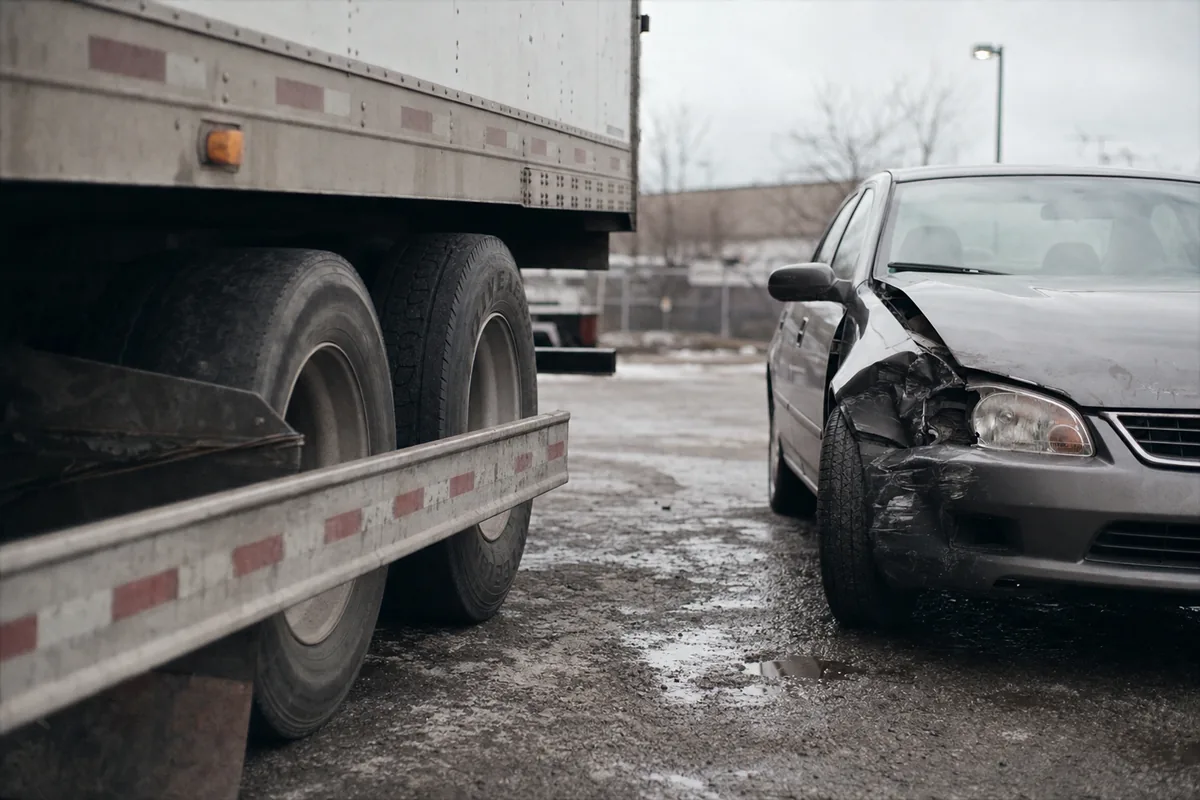
Short answer: Trucking cases in Detroit are not large car accidents. They are federally regulated, multi-defendant, evidence-rich claims governed by 49 CFR Parts 350-399 (the Federal Motor Carrier Safety Regulations) on top of Michigan tort law. Detroit's role as the eastern terminus of the Great Lakes freight corridor — feeding the Ambassador Bridge, I-75, I-94, and the Detroit Industrial Expressway — means commercial trucking traffic density per mile here exceeds almost anywhere else in the Midwest. The cases produce some of the largest recoveries in personal injury practice when the file is built correctly, and some of the most disappointing settlements when it is not.
This guide walks through what a Detroit truck accident lawyer actually does differently from a generalist car accident attorney, the federal regulations that frame the case, the specific corridor and crash patterns we see in Wayne County, the evidence that must be preserved within hours of the crash, and the damages model that drives top-tier outcomes.
Why Detroit Trucking Cases Are Federally Regulated
Every commercial motor vehicle in interstate commerce is subject to the Federal Motor Carrier Safety Regulations (FMCSR) at 49 CFR Parts 350-399. These regulations control hours of service, driver qualifications, vehicle maintenance, drug and alcohol testing, electronic logging, and dozens of other operational requirements. A Michigan plaintiff's lawyer who does not know the FMCSR is litigating a trucking case with one hand tied. The carrier's defense counsel will know the regulations cold. So will the FMCSR-specialist expert witnesses who testify in these cases. The standard of care for commercial drivers and motor carriers in Michigan tort cases is defined by these regulations.
The provisions that drive most Detroit cases:
- 49 CFR § 395 — Hours of service. Property-carrying drivers cannot drive more than 11 hours after 10 consecutive hours off-duty; cannot drive beyond the 14th consecutive hour after coming on duty; cannot drive after 60 hours on duty in 7 consecutive days (or 70 hours in 8). Violations are tracked on the electronic logging device (ELD) every commercial truck is required to carry under 49 CFR § 395.8.
- 49 CFR § 391 — Driver qualifications. Medical certifications, road test, driver application file. A driver disqualified from holding a CDL whose carrier put them on the road anyway creates a per se negligence-per-statute case.
- 49 CFR § 392 — Driving safety. Includes mandatory pre-trip inspections, prohibitions on driving while ill or fatigued, requirements for hazardous-condition decision-making.
- 49 CFR § 393 — Vehicle equipment. Brakes, lights, tires, load securement. Equipment-failure cases run through these rules.
- 49 CFR § 396 — Inspection, repair, and maintenance. Carriers must inspect vehicles systematically; maintenance records are discoverable.
- 49 CFR § 382 — Controlled substances and alcohol testing. Pre-employment, random, post-accident, reasonable-suspicion testing requirements. Failure to drug-test after a reportable accident is independently actionable.
Detroit's Trucking Geography: Why the Crashes Happen Where They Do
Detroit is the eastern anchor of one of the busiest freight networks in North America. The Ambassador Bridge alone moves roughly 25% of all merchandise trade between the U.S. and Canada. That commercial pressure concentrates on a small number of corridors:
- The Ambassador Bridge approach (I-75 / I-96 / Fort Street) in Southwest Detroit. Heavy commercial vehicle queueing, congestion-related rear-ends, and pre-bridge merge collisions are constant.
- I-75 through Detroit and the Downriver communities connecting to the I-275 freight loop and ultimately Ohio. The Wayne/Monroe county boundary segment is a recurring serious-injury zone.
- I-94 (Detroit Industrial Expressway) through Romulus past Detroit Metropolitan Airport. Ground transportation density for the airport plus the surrounding logistics parks (Wayne County's largest freight cluster) generates a continuous flow of truck crashes.
- I-96 (Jeffries Freeway) from downtown Detroit west through Livonia, Plymouth, and Novi. Trucks merging from M-39 and the I-275 interchange face short merge distances.
- I-696 across the northern boundary. Truck traffic between the Macomb Tech Center corridor and the Oakland/Wayne business parks.
- Telegraph Road, Michigan Avenue, and Eight Mile arterials. Last-mile commercial vehicles (Amazon, FedEx, UPS, food service) creating frequent intersection and pedestrian-strike incidents.
- Mound Road and Van Dyke (M-53) the GM Tech Center / Selfridge / Detroit Arsenal industrial truck corridor through Warren and Sterling Heights.
The Evidence That Wins Detroit Trucking Cases
Federal regulations require carriers to retain certain records. State tort law gives plaintiffs the right to discover them. The cases that resolve at the top of the range are the ones where counsel acted within hours to preserve evidence that disappears fast otherwise.
- Electronic logging device (ELD) data. The federally required ELD captures the driver's hours of service, on-duty/off-duty status, vehicle movement, and engine data continuously. Carriers can be required to produce the raw ELD file (not just printouts). Reconstructing the driver's last 14 days of duty status is foundational. Carriers retain ELD data for 6 months minimum under 49 CFR § 395.8(k); recoverable for longer if the carrier knows litigation is anticipated.
- Driver qualification file (DQF). Under 49 CFR § 391.51, the carrier must maintain a comprehensive file on each driver including medical certifications, prior employer references, driving record checks, road test certifications, and disciplinary records.
- Vehicle maintenance and inspection records. Under 49 CFR § 396, every truck must have documented periodic inspections and repair records. A pattern of deferred brake maintenance or skipped pre-trip inspections is independently actionable.
- Drug and alcohol testing records. Post-accident testing is required under 49 CFR § 382.303 for reportable crashes. Failure to test, or positive test results, become central case facts.
- Dashcam and event data recorder (EDR) data. Most modern commercial trucks carry forward-facing and driver-facing cameras. The recording window is typically short — sometimes overwritten within hours of the crash unless preserved.
- Dispatch records and bills of lading. Establishes what the driver was carrying, where they came from, what schedule they were under, and whether the carrier dispatched the driver in violation of HOS rules.
- Carrier safety record from FMCSA's SAFER system. Public crash history, inspection violations, and safety scores establish the carrier's pattern of conduct.
The single most important action in a Detroit trucking case is the preservation letter sent to the carrier within days of the crash. Without that letter, the carrier can lawfully overwrite ELD data, recycle dashcam footage, and dispose of damaged vehicle components. With it, deliberate destruction creates spoliation sanctions.
Multiple Defendants, Multiple Insurance Policies
A Detroit trucking case is rarely a one-defendant lawsuit. The potentially liable parties typically include:
- The driver — for the immediate driving conduct.
- The motor carrier (trucking company) — through respondeat superior plus direct negligence theories (negligent hiring, training, supervision, retention, dispatch).
- The vehicle owner — if different from the carrier.
- The trailer owner or lessor — if the trailer was separately leased or owned.
- The shipper or broker — under certain theories if they were aware of carrier safety issues or dispatched loads in violation of HOS.
- The vehicle manufacturer or component manufacturer — in product liability cases (brake defects, tire failures, steering or suspension component failures).
- A maintenance contractor — if periodic inspection or repair was outsourced.
- The loader — for cargo-shift cases caused by improper load securement.
Each potentially liable party may carry its own insurance policy. Commercial trucking insurance policies typically start at the federal minimum of $750,000 (for general freight) and run to $5 million or more for hazardous-materials carriers. Many large fleets self-insure for the first few million dollars and have excess coverage layered above. Identifying every available coverage source is critical — sometimes single-defendant settlements leave seven or eight figures of recoverable coverage untouched.
The Wayne County Plaintiff Strategy
Trucking defendants are typically represented by sophisticated defense counsel funded by commercial general liability insurers. The defense strategy is consistent: identify any plaintiff conduct that contributed to the crash, exploit Michigan's modified comparative negligence rule (MCL § 600.2959 — more than 50% at fault bars non-economic damages entirely), retain motion-friendly defense experts, and push the case to trial only when settlement value approaches policy limits. The plaintiff strategy that beats this:
- Fast evidence preservation via spoliation letters and (where necessary) court orders.
- Independent accident reconstruction using EDR data, scene measurements, and (where available) dashcam footage. Reconstruction has to start before the vehicles are repaired or salvaged.
- FMCSR-violation-based theories of liability presented as negligence per se, supported by FMCSR-specialist expert witnesses.
- Driver depositions structured around the ELD timeline. Defense routinely settles cases once the driver's deposition demonstrates hours-of-service violations or fatigue.
- Wayne County Circuit Court (Third Judicial Circuit) venue. Wayne County juries are familiar with commercial trucking risk and have returned substantial verdicts when the case is properly built.
- Trial-readiness from the first offer. Carriers' bid-and-ask process is calibrated to firms' actual trial willingness. The firms that try cases see higher first offers.
Detroit Hospitals That Receive Trucking Trauma
Catastrophic trucking injuries in Wayne County typically arrive at:
- Detroit Receiving Hospital (DMC) — Detroit's Level I trauma center, the primary destination for the most severe injuries.
- Henry Ford Hospital (West Grand Blvd) — Level I trauma, tertiary care.
- Beaumont-Dearborn — Level II trauma, serving western Wayne County.
- Children's Hospital of Michigan (DMC) — pediatric trauma center.
- Rehabilitation Institute of Michigan (DMC) — post-acute rehabilitation for catastrophic injury survivors.
Realistic Damages Model for Detroit Trucking Cases
Trucking-case damages run higher than passenger-vehicle cases for two reasons: the impact forces are greater (a loaded semi weighs up to 80,000 pounds), and the insurance coverage available is larger. Approximate ranges:
- Soft-tissue injury, no surgery, full recovery: $25,000-$150,000 range. Higher than equivalent car accident because of higher policy limits.
- Significant orthopedic injury (disc, fracture requiring surgery), return to work with restrictions: $250,000-$1,000,000+.
- Traumatic brain injury (documented): $1,000,000-$10,000,000+ depending on severity. See our mild TBI guide.
- Spinal cord injury / paralysis: $1,000,000-$15,000,000+. See our spinal cord injury pillar.
- Amputation: $1,000,000-$10,000,000+. Lifetime prosthetic, modification, and earnings analysis drives the number.
- Wrongful death: Highly variable. Working-age decedents with documented earnings produce settlements regularly in the millions. Outside the medical malpractice context, no cap.
Past results do not guarantee future outcomes. See our complete case-value framework in the Michigan personal injury case value pillar.
Frequently Asked Questions — Detroit Truck Accident Lawyer
Q: How is a Detroit truck accident case different from a car accident case? Two big differences. First, the trucking case is governed by federal regulations (49 CFR Parts 350-399) on top of Michigan tort law. Second, the coverage and corporate-defendant complexity is bigger — typically multiple defendants (driver, carrier, owner, possibly broker and shipper) and policies starting at $750,000 to several million dollars. Both factors require attorney expertise that generalist car accident lawyers often lack.
Q: How long do I have to file a Detroit truck accident lawsuit? Three years from the date of injury under MCL § 600.5805 for the third-party tort claim. One year per individual expense for PIP benefits under MCL § 500.3145. Government-entity defendants (MDOT trucks, county trucks) require a separate 120-day written notice under MCL § 691.1404. Wrongful death is three years from the date of death under MCL § 600.2922.
Q: What evidence should I preserve after a Detroit truck accident? Send a spoliation letter to the carrier immediately. Demand preservation of the ELD data, the driver qualification file, the maintenance records, the dashcam footage, the dispatch records, and the trip documentation. The faster the letter goes out, the more evidence is preserved. We send the letter within days of accepting representation.
Q: Who pays my medical bills after a Detroit truck accident? Your own auto insurer pays PIP benefits regardless of fault under MCL § 500.3107. Coverage depends on the PIP tier you elected (unlimited, $500K, $250K, $50K, or opt-out). If your tier is exhausted by your medical bills, the at-fault driver and carrier's liability coverage can fill the gap once the third-party case resolves.
Q: What if the truck was from out of state? Michigan no-fault still applies to your PIP benefits if you're a Michigan resident. The third-party tort claim against the out-of-state driver and carrier is filed in Michigan state court (typically Wayne County Circuit Court for Detroit crashes) or in federal court (Eastern District of Michigan) if diversity jurisdiction applies and the amount in controversy exceeds $75,000.
Q: What if the trucking company says the driver was an independent contractor? The carrier remains liable in many circumstances even where the driver is classified as an independent contractor — particularly where the carrier exercised control over routes, schedules, or dispatch. The doctrine of statutory employment under FMCSA regulations also imputes liability to the carrier in many lease arrangements. Independent-contractor defenses fail more often than they succeed.
Q: How much does a Detroit truck accident lawyer cost? Standard Michigan contingency fee: 33⅓% of the recovery pre-trial, sometimes 40% if the case goes to trial. Costs (filing fees, experts, depositions, records) reimbursed from the recovery. No upfront cost. No fee if no recovery.
Speak With a Detroit Truck Accident Lawyer
If you or a loved one was injured in a commercial trucking crash anywhere in Wayne County or Southeast Michigan, contact Koussan Law for a free, confidential consultation. We send the preservation letter within days. We accept Michigan trucking cases on contingency — you pay nothing unless we recover. Our trial record includes a $14.95 million jury verdict against Pontiac General Hospital in a sexual assault and institutional negligence case, a $6 million slip-and-fall settlement that stood as Michigan's largest known of its kind under the former open-and-obvious doctrine, and arguments before the Michigan Supreme Court. Call (313) 800-0000, request a consultation online, or use our free case calculator.
Related Resources
- Trucking Accidents — full service page
- Detroit Personal Injury Lawyer — our home-city overview
- Wayne County Personal Injury Lawyer — county-level hub
- Auto Accidents
- Catastrophic Injury
- Michigan No-Fault Attorney
- Michigan Spinal Cord Injury Lawyer
- Michigan Personal Injury Case Value Guide
Past results do not guarantee future outcomes. Every trucking case is fact-specific and depends on the injury, the available evidence, the carrier's safety record, the applicable insurance coverage, and qualified expert review. This article is for general informational purposes and is not legal advice. Reading this article does not create an attorney-client relationship with Koussan Law.