Detroit Medical Malpractice Lawyer: How These Cases Are Built Differently
Short answer: Michigan medical malpractice cases are subject to procedural rules and damages caps that do not apply to any other personal injury claim. Filing requires a mandatory Notice of Intent sent at least 182 days before the lawsuit, followed by an Affidavit of Merit from a qualified expert at the time of filing. The statute of limitations is shortened to two years under MCL § 600.5838a, one year shorter than the standard three-year deadline. Non-economic damages are capped under MCL § 600.1483 at two inflation-adjusted tiers (a standard cap and a higher catastrophic-injury cap). Defense counsel exploits every one of these procedural and substantive limits aggressively. A Detroit medical malpractice lawyer's value comes from knowing exactly how to navigate each one — and from a willingness to try cases that defense carriers expect to be settled at a discount.
This guide walks through the Michigan medical malpractice framework as it operates today, the Detroit hospital systems where most of the cases arise, the categories of medmal claims we see most often, the procedural traps that kill cases, the damages cap mechanics, and the firm's track record in this practice area.
Why Michigan Medical Malpractice Is Different from Every Other Personal Injury Case
The Michigan legislature has progressively raised the procedural and substantive barriers to medical malpractice claims since the mid-1990s tort reform era. The current framework imposes:
- Two-year statute of limitations under MCL § 600.5838a, accruing from the date the claim "accrues" — typically the date of the negligent act or omission. A six-year statute of repose creates an outer limit.
- The "discovery rule" under MCL § 600.5838a(2) allows a claim filed within six months after the plaintiff discovers (or should have discovered) the existence of the claim, but no later than six years after the negligent act.
- Mandatory Notice of Intent (NOI) under MCL § 600.2912b. The NOI must be served on each potential defendant at least 182 days before filing suit, except in shortened-notice situations where the SOL is about to expire (then 91 days). The NOI must contain specific statutory elements: factual basis, applicable standard of care, alleged breach, alleged causation, and injuries claimed.
- Affidavit of Merit (AOM) under MCL § 600.2912d. Must be filed with the complaint. Must be signed by a health professional who would qualify as an expert at trial under MCL § 600.2169 — including the requirement of having spent the majority of professional time in clinical practice (or teaching of clinical practice) during the year preceding the alleged malpractice.
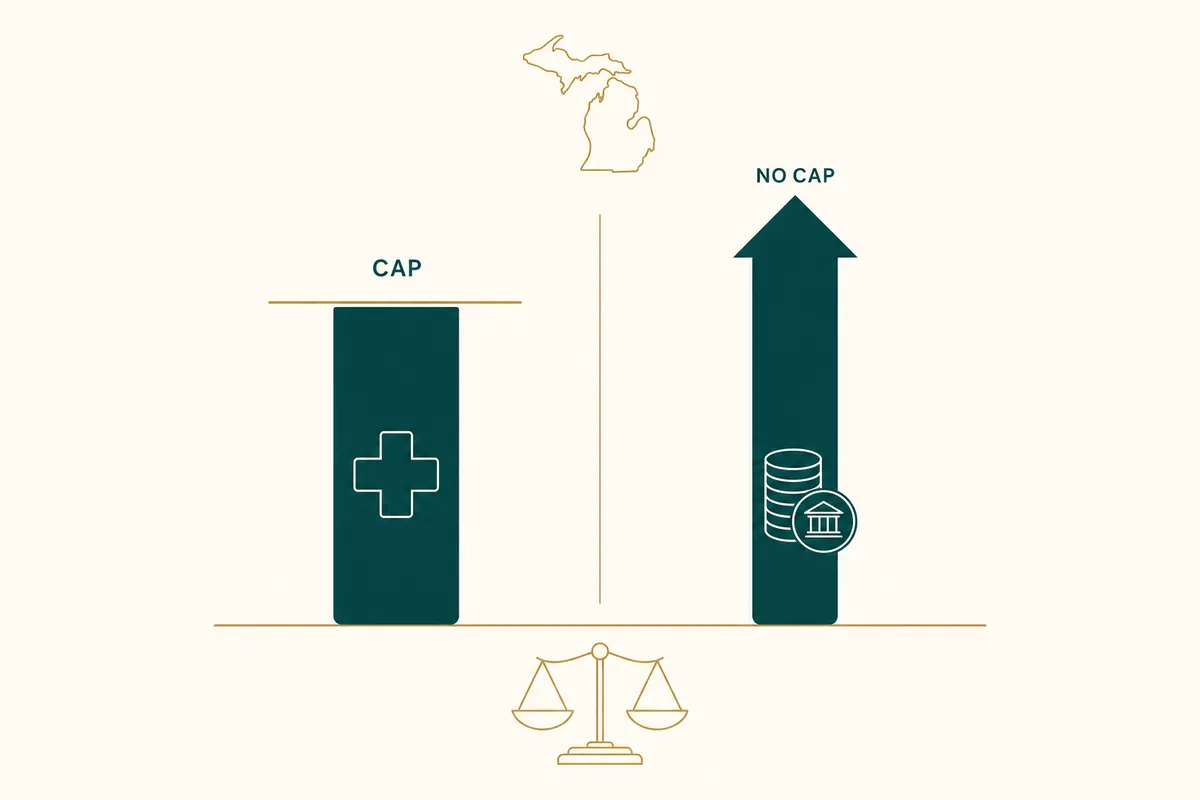
- Damages caps under MCL § 600.1483. Two-tier caps adjusted annually for inflation. In 2026, the standard cap sits in the mid six figures; the higher tier (for loss of bodily function, paralysis, and certain catastrophic outcomes) approximately doubles the standard cap.
- The expert qualification rules under MCL § 600.2169. The expert testifying at trial on standard of care must, at the time of the alleged malpractice, have specialized in the same specialty as the defendant. For a defendant board-certified specialist, the expert must also be board-certified in the same specialty. This rule alone kills many malpractice cases at summary disposition.
- Periodic-payment requirements for large verdicts under MCL § 600.6307, allowing the defendant to convert future damages into a structured payment plan.
These rules combine to make Michigan medical malpractice cases among the most procedurally demanding in personal injury practice. A Detroit medical malpractice lawyer's first job is to verify that the case can clear every procedural hurdle before substantial investment in expert review.
Detroit Hospital Systems and Where Cases Arise
Detroit's tertiary-care infrastructure includes some of the largest hospital systems in the Midwest. Our cases arise across the entire ecosystem:
- Detroit Medical Center (DMC) — Detroit Receiving Hospital (Level I trauma), Harper University Hospital, Hutzel Women's Hospital, Children's Hospital of Michigan, Karmanos Cancer Institute, Rehabilitation Institute of Michigan, Sinai-Grace Hospital. Detroit's largest hospital system by acute-care bed count.
- Henry Ford Health — Henry Ford Hospital (West Grand Blvd flagship), Henry Ford St. John (Moross Road), Henry Ford Wyandotte, Henry Ford West Bloomfield, Henry Ford Macomb (Clinton Township and Warren), Henry Ford Kingswood (Ferndale), and the Henry Ford Medical Group ambulatory network.
- Corewell Health (formerly Beaumont) — Beaumont-Dearborn (Level II trauma), Beaumont Royal Oak (flagship Oakland County trauma center), Beaumont Troy, Beaumont Farmington Hills, Beaumont Wayne, Beaumont Trenton, Beaumont Grosse Pointe.
- Trinity Health (formerly St. Joseph Mercy) — St. Joseph Mercy Oakland (Pontiac), St. Joseph Mercy Livingston, St. Mary Mercy Livonia.
- McLaren Health Care — McLaren Oakland (Pontiac), McLaren Macomb (Mount Clemens), McLaren Bay Region, McLaren Flint.
- Ascension Michigan — Providence Hospital (Southfield), Ascension Macomb-Oakland (Warren / Madison Heights), and the Ascension medical group.
- Wayne State University Physician Group / Wayne Health — the academic medical practice associated with Wayne State University School of Medicine, embedded across the DMC system.
- Independent surgical centers, urgent-care chains, and outpatient providers — concentrated along Telegraph Road, Woodward Avenue, Big Beaver Road, and Hall Road.
Defense counsel for these systems is typically among Michigan's most experienced medical malpractice defense bar. The cases that succeed against them require equally experienced plaintiff counsel.
Categories of Detroit Medical Malpractice Cases
- Surgical errors. Wrong-site surgery, retained surgical instruments, intraoperative organ damage, anesthesia errors, post-operative infection management failures. Subject to MCL § 600.5838a two-year SOL plus MCL § 600.1483 damages caps.
- Birth injury and obstetrical malpractice. Failure to diagnose fetal distress, delayed C-section, brachial plexus / Erb's palsy from shoulder dystocia, hypoxic-ischemic encephalopathy. See our cerebral palsy birth injury guide and Erb's palsy / brachial plexus guide. Birth-injury cases have an extended statute of limitations for the minor child under MCL § 600.5851.
- Misdiagnosis and delayed diagnosis. Failure to diagnose cancer, heart attack, stroke, pulmonary embolism, sepsis, meningitis. The defense focus is causation — whether the misdiagnosis materially changed the outcome.
- Medication errors. Wrong drug, wrong dose, drug interactions, anticoagulant management failures, opioid prescribing failures, contrast media reactions. Particularly common in elderly patients on polypharmacy regimens.
- Emergency room errors. Failure to triage appropriately, missed fractures, missed cardiac events, premature discharge.
- Hospital-acquired infections (HAIs). MRSA, C. difficile, ventilator-associated pneumonia, central-line-associated bloodstream infections, surgical site infections. Subject to the standard-of-care framework under federal CMS quality reporting.
- Anesthesia errors. Intubation failures, anesthetic awareness, anoxic brain injury, post-anesthetic monitoring failures, dosing errors. Frequently lead to catastrophic outcomes.
- Pressure ulcers and nursing home / hospital neglect. Stage III and IV pressure ulcers in immobilized hospitalized or nursing-home patients. See our bedsores pressure ulcers guide.
- Diagnostic imaging errors. Missed findings on CT, MRI, mammography. Radiology defendant cases are subject to the same medical malpractice rules as physician defendants.
- Informed consent failures. Failure to disclose material risks, alternatives, or expected outcomes prior to procedure.
The Damages Caps: Why the Numbers Matter
Michigan caps non-economic damages in medical malpractice cases under MCL § 600.1483. The caps adjust annually for inflation and operate on a two-tier scheme:
- Standard cap — applies to most cases. Currently in the mid six figures.
- Higher cap (approximately 2x standard) — applies when the case involves total loss of vision, hearing, or reproductive capability; permanent loss of use of a limb; or permanent and substantial loss of mental capacity (e.g., catastrophic brain injury, paralysis, persistent vegetative state).
Economic damages (past + future medical, lost earnings, life-care needs) are NOT capped. The cap only limits the non-economic component (pain and suffering, loss of enjoyment of life, loss of consortium). In serious cases the economic damages can substantially exceed the cap, particularly for young plaintiffs with long projected life expectancies.
The cap mechanics drive case selection. Cases with substantial economic damages — children with lifelong care needs, working-age plaintiffs with permanent disability — produce verdicts that meaningfully exceed the cap because the economic side scales freely. Cases that turn primarily on pain-and-suffering exposure are constrained by the cap and may not be cost-effective for a contingency fee firm to develop unless the standard-of-care evidence is overwhelming.
Pre-Suit Workflow: The 6 Months Before Filing
Michigan medmal cases take longer to develop than ordinary PI cases because the Notice of Intent period creates a statutory waiting window. A typical timeline:
- Client intake and preliminary review (week 1). Initial conversation, medical-record authorization signed.
- Records retrieval (weeks 2-6). Complete certified copies from every involved provider — hospital, physicians, ambulatory, diagnostic imaging, pharmacy, prior-treatment baseline.
- Expert review (weeks 6-12). The records go to a qualified expert (or experts) in the defendant's specialty for standard-of-care and causation opinions. Most cases get screened out at this stage.
- Notice of Intent drafting and service (week 12-13). The NOI must contain the statutory elements under MCL § 600.2912b. Defects in the NOI can dismiss the case post-filing.
- 182-day statutory waiting period (weeks 13-39). The NOI period creates time for pre-suit settlement, but most cases proceed to suit.
- Affidavit of Merit and Complaint filing (week 39+). The AOM under MCL § 600.2912d must be filed with the complaint. The AOM must come from an expert who meets the MCL § 600.2169 specialty-qualification rules.
- Discovery (months 9-24). Records, party depositions, expert disclosure, expert depositions.
- Mediation, settlement, or trial (months 24-36).
Detroit-Specific Considerations
- Wayne County Circuit Court (Third Judicial Circuit) handles most Detroit-arising medmal cases. Judges and case management procedures vary; familiarity with the bench matters.
- Eastern District of Michigan for federal cases involving federal-employee defendants (Detroit VA, certain federally-qualified health centers) under the Federal Tort Claims Act, which has its own pre-suit administrative claim requirements and a two-year SOL.
- Wayne State University Physician Group cases may involve governmental-immunity defenses under MCL § 691.1407, which interact with the medical malpractice framework in complex ways.
- Indigent client representation. Detroit's economic profile means many medmal victims are uninsured or underinsured. Contingency-fee representation makes these cases accessible.
Settlement Ranges and Verdict Examples
Approximate ranges, highly variable by injury severity and cap-tier eligibility:
- Cases not meeting threshold or causation: Often non-viable; expert review screens these out.
- Standard-cap cases with moderate economic damages: $250,000-$750,000.
- Higher-cap eligible cases (catastrophic outcomes): Frequently $1,000,000-$5,000,000+ depending on economic damages.
- Birth injury with lifelong care needs: Frequently $3,000,000-$15,000,000+. Economic damages dominate.
- Wrongful death medical malpractice cases: Subject to the cap plus the wrongful death framework under MCL § 600.2922. Variable.
Koussan Law's $14.95 million jury verdict against Pontiac General Hospital is classified as sexual assault and institutional negligence, not medical malpractice — it sits outside the MCL § 600.1483 damages caps. Past results do not guarantee future outcomes.
Frequently Asked Questions — Detroit Medical Malpractice Lawyer
Q: How long do I have to file a Detroit medical malpractice lawsuit? Generally two years from the date of the negligent act under MCL § 600.5838a. A six-month discovery rule may extend the deadline in specific cases. A six-year statute of repose creates an outer limit. Birth injury cases have extended deadlines for minor children under MCL § 600.5851.
Q: What is a Notice of Intent? Under MCL § 600.2912b, a Notice of Intent must be served on each potential defendant at least 182 days before the lawsuit is filed (91 days if the SOL is about to expire). The NOI must include factual basis, applicable standard of care, alleged breach, causation, and injuries — defects in the NOI can dismiss the case.
Q: What is an Affidavit of Merit? Under MCL § 600.2912d, the AOM is signed by a qualified medical expert and filed with the complaint. The expert must meet the specialty-qualification rules of MCL § 600.2169. The AOM serves as the case's pre-filing certification that a qualified expert believes the claim has merit.
Q: What are the damages caps? MCL § 600.1483 caps non-economic damages on a two-tier scheme adjusted annually for inflation. Standard cap (mid six figures in 2026); higher cap (approximately double, for catastrophic outcomes including loss of bodily function, paralysis, permanent and substantial loss of mental capacity). Economic damages (medical, wage loss, future care) are not capped.
Q: How much does a Detroit medical malpractice lawyer cost? Contingency fee. Standard structure is 33⅓% of the recovery pre-trial, sometimes 40% if the case goes to trial. Costs (medical records, expert witnesses, depositions, court filing) are reimbursed from the recovery. No upfront cost. No fee if no recovery.
Q: How long does a Detroit medical malpractice case take? The Notice of Intent process plus discovery makes these cases longer than ordinary PI matters. Most resolve in 24-36 months from initial intake. Complex cases involving multiple defendants and expert-heavy proof can take longer.
Q: Will I have to testify? Yes, in most cases. The plaintiff's deposition is a standard part of medmal litigation. Trial testimony is required for any case that does not settle or proceed by binding alternative dispute resolution. Counsel prepares clients extensively for both.
Q: Can I sue if my loved one died from medical malpractice? Yes, through the personal representative of the estate under Michigan's wrongful death statute (MCL § 600.2922) combined with the medical malpractice framework. The two-year medmal SOL applies (with the discovery rule). Damages caps under MCL § 600.1483 apply to the non-economic component. See our Detroit wrongful death lawyer guide.
Speak With a Detroit Medical Malpractice Lawyer
If you believe you or a loved one was harmed by medical negligence at a Detroit-area hospital, clinic, or outpatient provider, contact Koussan Law for a free, confidential consultation. The two-year statute of limitations and the 182-day Notice of Intent period make speed critical. Koussan Law does not litigate medical malpractice in-house. We review your situation at no cost and connect it with an experienced Michigan medical malpractice firm in our referral network, so the two-year deadline and the Notice of Intent requirement are handled by counsel who do this work every day. Call (313) 800-0000, request a consultation online, or use our free case calculator.
Related Resources
- Medical Malpractice — service page
- Surgical Errors
- Misdiagnosis / Delayed Diagnosis
- Medication Errors
- Birth Injuries
- Emergency Room Errors
- Detroit Personal Injury Lawyer
- Wayne County Personal Injury Lawyer
- Cerebral Palsy Birth Injury Michigan
- Erb's Palsy / Brachial Plexus Birth Injury
- Bedsores and Pressure Ulcers in Michigan Nursing Homes
- Detroit Wrongful Death Lawyer
- Michigan Personal Injury Case Value Guide
Past results do not guarantee future outcomes. Every medical malpractice case is fact-specific and depends on standard of care, causation, the applicable damages cap tier, expert qualification, the Notice of Intent and Affidavit of Merit requirements, and qualified expert review. The damages cap figures referenced are illustrative; current amounts adjust annually with inflation. This article is for general informational purposes and is not legal advice. Reading this article does not create an attorney-client relationship with Koussan Law.