Detroit Car Accident Lawyer: The Complete 2026 Guide
Short answer: A Detroit car accident triggers two parallel insurance systems under Michigan law. (1) Your own auto insurer pays Personal Injury Protection (PIP) benefits — medical, wage loss, replacement services — regardless of fault under MCL § 500.3107. (2) The at-fault driver's liability policy covers pain and suffering and economic damages above PIP only if your injuries meet the serious-impairment-of-body-function threshold under MCL § 500.3135. The 2019 reform (PA 21 of 2019, codified at MCL § 500.3107c) introduced five PIP coverage tiers that fundamentally changed what "full coverage" means in Detroit and the rest of Michigan. A Detroit car accident lawyer's job is to navigate both systems simultaneously, identify every available coverage source, and recover the maximum supported by the evidence.
This guide walks through the no-fault framework as it operates today in Wayne County, the five PIP tiers and what they mean for Detroit residents, the threshold for suing the at-fault driver, mini-tort vehicle damage, the deadlines that bar claims, the corridor and crash patterns we see most in Detroit, and the damages model that produces top-tier outcomes.
Why Hiring a Detroit Car Accident Lawyer Matters
The same case settles for different amounts depending on who represents you. Insurance carriers run reserves and offers against the firm-name on the file. A firm with no trial history sees lower first offers; a firm with verdicts on its record sees higher. Detroit's car accident lawyer market includes everything from billboard mills that settle every case to trial firms that take cases through verdict. The market knows which is which.
Koussan Law's trial record includes a $14.95 million jury verdict against Pontiac General Hospital in a sexual assault and institutional negligence case (Ali Koussan served as sole plaintiff attorney against four defense attorneys), a $6 million premises liability settlement, and arguments before the Michigan Supreme Court. Past results do not guarantee future outcomes — but they shape every adjuster's view of our cases.
Michigan PIP Benefits: What Your Own Insurer Owes You
Under MCL § 500.3107, PIP covers four categories regardless of fault:
- Allowable medical expenses — hospital, physician, surgery, physical therapy, prescription medications, medical equipment, attendant care, and rehabilitation. Subject to your elected coverage tier and the medical fee schedule introduced by the 2019 reform.
- Wage loss benefits — 85% of your gross income, capped at a statutorily-adjusted monthly maximum (approximately $7,500/month in 2026), paid for up to three years from the date of the accident.
- Replacement services — $20 per day toward services you can no longer perform yourself (housekeeping, lawn care, child care), for up to three years.
- Survivor's loss benefits — paid to dependents if the insured is killed in the crash. Lost income plus replacement services for three years.
PIP coverage is mandatory for every Michigan-registered vehicle. If you have no auto policy, the Michigan Assigned Claims Plan (MCL § 500.3171) may be your only PIP source, with reduced benefits ($250,000 cap) and strict deadlines.
The Five PIP Coverage Tiers — and What Detroit Drivers Should Know
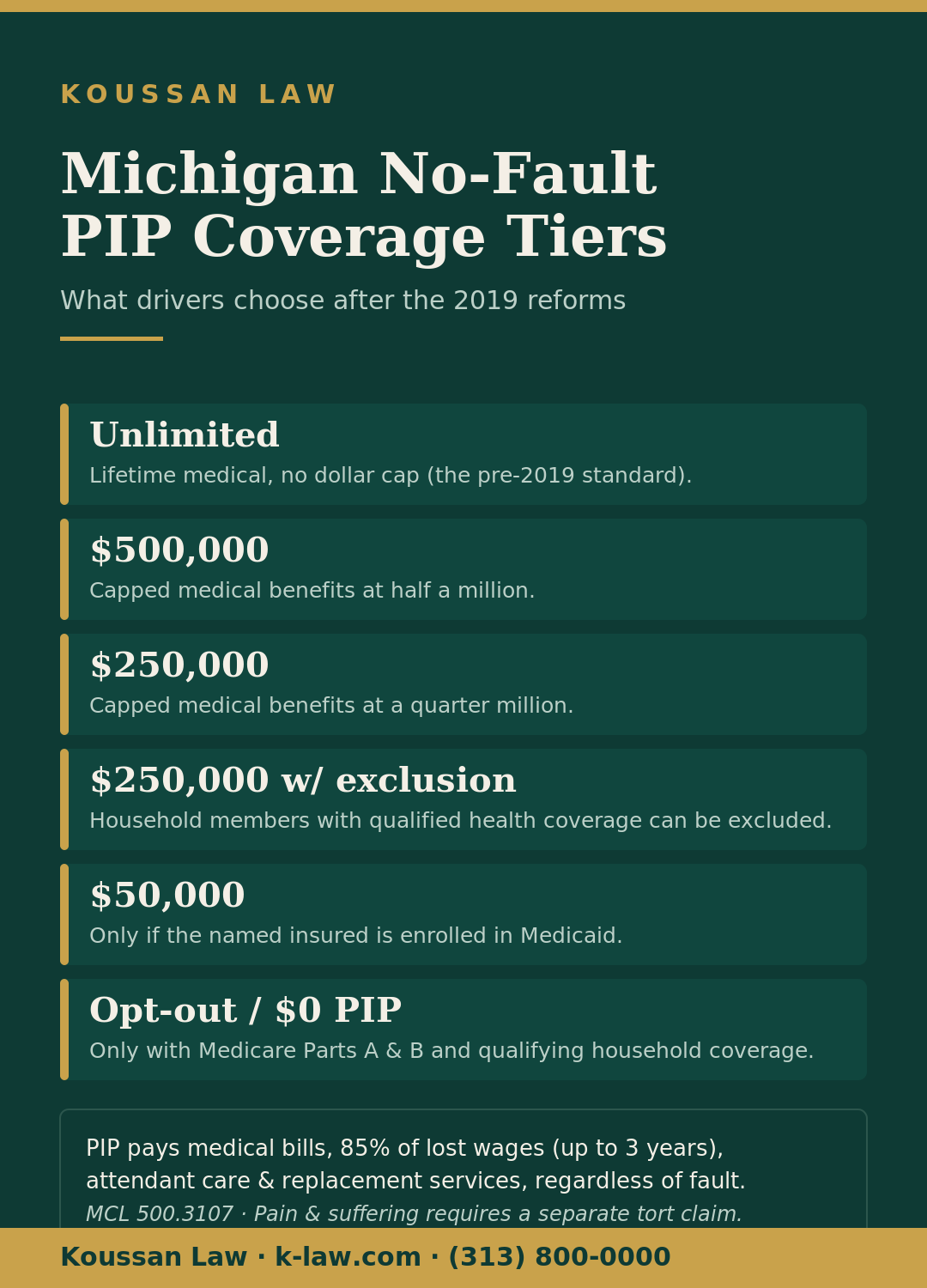
Before the 2019 reform, every Michigan driver carried unlimited lifetime PIP medical coverage. PA 21 of 2019 (effective July 2, 2020) replaced that with five elected tiers under MCL § 500.3107c:
- Unlimited PIP — the legacy default. No cap on medical benefits for the life of the injured person. Highest premium but the only tier that fully protects against catastrophic injury.
- $500,000 PIP — covers up to $500,000 in medical expenses. Adequate for moderate injury but easily exhausted by serious orthopedic surgery, TBI rehabilitation, or any spinal cord injury.
- $250,000 PIP — covers up to $250,000. A single major surgery and ICU stay can consume most of this.
- $50,000 PIP — only available to Medicaid recipients with qualifying private health insurance. A serious accident exhausts this in weeks.
- PIP opt-out — only available if every named insured and resident spouse has qualifying Medicare (Parts A and B) coverage. Health insurance becomes primary.
Detroit residents face a particular trap: the $50,000 tier saves approximately $40-100/month in premiums, looks attractive to households watching every dollar, and leaves the household catastrophically exposed if any family member suffers a serious injury. We've represented clients who saved $40 a month and ended up with hundreds of thousands of dollars in uncovered medical bills after a freeway crash. Choose your PIP tier as if your life depends on it, because it does.
The Threshold: When You Can Sue the At-Fault Driver
Pain and suffering damages against the at-fault driver are recoverable only if your injury meets the threshold under MCL § 500.3135. The statute requires that the injury result in death, permanent serious disfigurement, or serious impairment of body function. The Michigan Supreme Court refined the standard in McCormick v. Carrier, 487 Mich. 180 (2010), requiring an objectively manifested impairment of an important body function affecting the person's general ability to lead his or her normal life.
Common injuries that meet the threshold:
- Documented herniated discs with positive imaging.
- Fractures requiring surgical hardware.
- Traumatic brain injuries with objective neuropsychological deficits.
- Ligament tears requiring reconstructive surgery.
- Chronic pain conditions confirmed by imaging.
- Permanent scarring or disfigurement.
Common cases that fall short:
- Soft tissue strains and sprains with full recovery.
- Self-reported pain without objective findings.
- Brief courses of conservative treatment with full return to normal life.
The threshold analysis is fact-intensive and litigation-driven. A Detroit car accident lawyer's preparation around the threshold — including which physicians to refer to, which testing to order, and which records to assemble — often makes or breaks the case at summary disposition.
The Mini-Tort: Vehicle Damage Recovery
Under MCL § 500.3135(3)(e), you can recover up to $3,000 in vehicle damage from the at-fault driver, in excess of your collision-coverage payout. The other driver must have been more than 50% at fault. The mini-tort applies regardless of whether the serious-impairment threshold is met. One-year deadline. The cap was raised from $1,000 to $3,000 in the 2019 reform. For the step-by-step claim process — who qualifies, the evidence to assemble, and how to file in small claims court — see our Michigan mini tort guide.
Detroit Car Accident Geography: Where the Crashes Happen
Detroit's road network mixes mid-century freeway design, dense urban arterials, and aging surface streets. The concentrations:
- I-94 (Edsel Ford Freeway) through the east side — particularly the segment between Conner Avenue and I-75 — among the most accident-prone freeway segments in Michigan. Rush-hour chain-reactions and late-night high-speed crashes.
- I-75 and the Lodge Freeway (M-10) interchange near downtown — short merges and tight curves funneling commuter and commercial traffic.
- Jeffries Freeway (I-96) between Livernois and the Lodge — short merge distances, aggressive lane changes, lighting deficits.
- Eight Mile Road — Detroit's northern boundary, persistent T-bone and pedestrian-strike risk.
- Woodward Avenue (M-1) — Downtown through Midtown to Palmer Park. QLINE streetcars, pedestrians, parallel parking, and frequent signalized intersections create conflict points.
- Gratiot Avenue (M-3) — the east-side commercial corridor; intersection collisions between Van Dyke and I-94.
- Michigan Avenue (US-12) through Corktown and Mexicantown — stadium event nights and growing residential development outpace mid-century road design.
- Grand River Avenue (M-5) — northwestern commuter corridor.
- I-375 and the Jefferson Avenue corridor — riverfront and entertainment-district crashes spike on event nights with rideshare-density surges.
- Telegraph Road (US-24) and the Lodge connector ramps — long unprotected left-turn intersections.
The Three Deadlines Every Detroit Driver Must Know
- One-year PIP deadline (MCL § 500.3145). You must apply for PIP benefits within one year of each individual loss — not one year from the accident. A medical bill from month 14 has its own one-year clock running from the date of treatment. Carriers wait this out routinely on bills they intend to deny.
- Three-year tort deadline (MCL § 600.5805). Three years from the date of the accident to file a third-party negligence lawsuit. Government-entity defendants (City of Detroit, Wayne County, MDOT, DDOT) require a separate 120-day written notice under MCL § 691.1404, which is shorter and earlier than the three-year deadline.
- Mini-tort one-year deadline (MCL § 500.3145). Same one-year limit applies to the $3,000 vehicle damage claim.
These deadlines are absolute. Michigan courts almost never grant equitable extensions.
What to Do in the First 72 Hours After a Detroit Car Accident
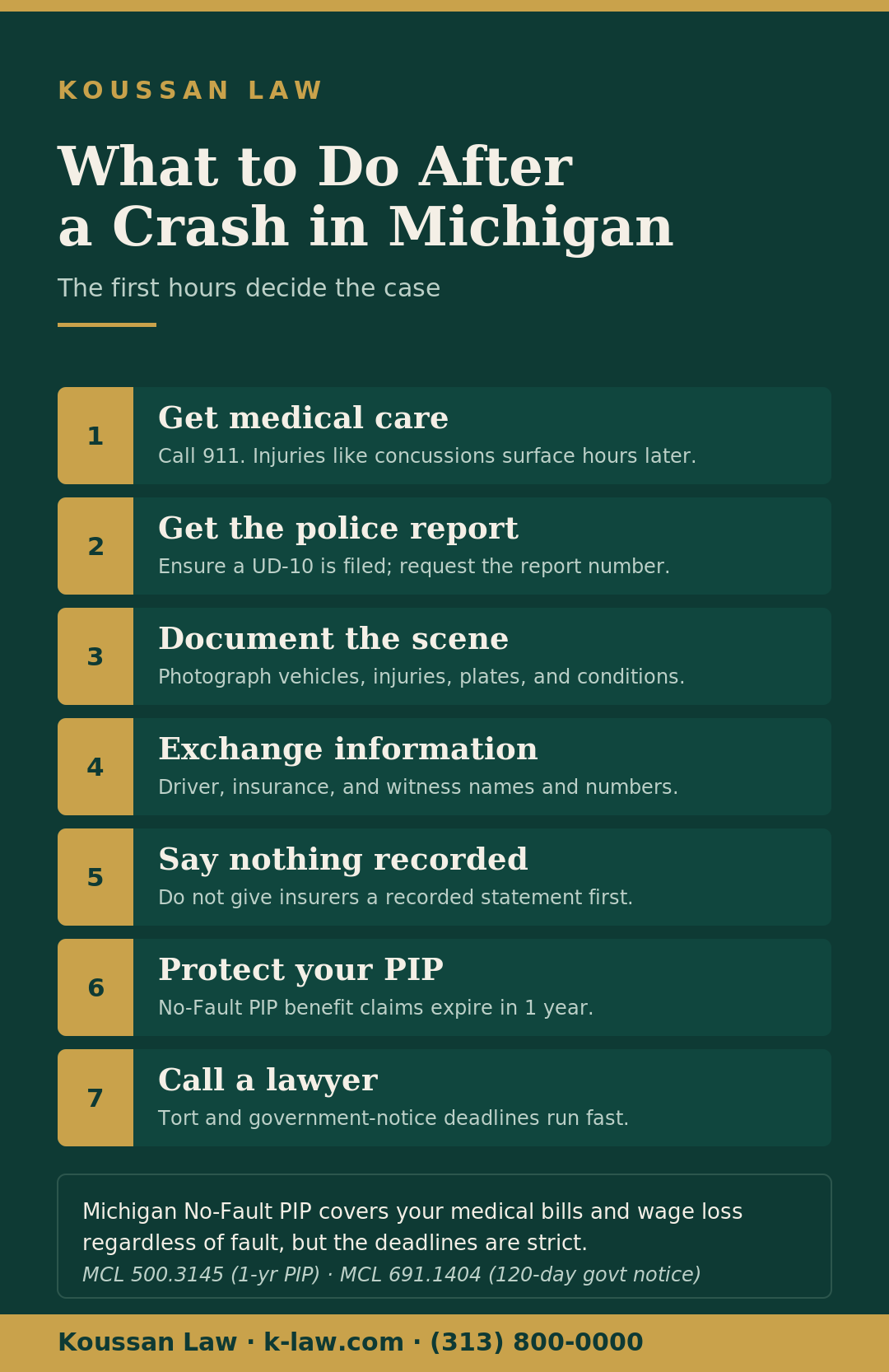
- Get medical care immediately — same day, even if you "feel fine." Adrenaline masks soft-tissue and head injuries; same-day documentation is foundational. Detroit ER options include DMC Detroit Receiving, Henry Ford Hospital, Sinai-Grace, and Beaumont-Dearborn for western Wayne crashes.
- Get the police report number and the responding officer's badge. Detroit Police Department reports are typically available within 5-10 business days. State Police reports for freeway crashes are similar. Without the report, the claim is much harder to build.
- Photograph everything. Vehicles, scene, road conditions, traffic signals, weather. The first ten minutes of photos are often more valuable than any later evidence.
- Get contact info for every witness. Name, phone, email. Witnesses disappear fast.
- Do not give a recorded statement to the at-fault driver's insurer. They will use anything you say to reduce or deny the claim. Politely decline; tell them counsel will be in touch.
- File the PIP claim with your own insurer immediately. The one-year clock starts ticking on the first medical bill. Do not delay because you are still figuring out what happened.
- Contact a Detroit car accident lawyer within days. The combination of the priority-insurer analysis, the threshold preparation, and the evidence preservation requires fast attorney involvement. Most cases that under-resolve do so because attorney engagement happened weeks too late.
What Detroit Insurance Carriers Argue and How We Fight Back
Detroit auto insurance adjusters and defense counsel run consistent playbooks:
- "The IME doctor says you've reached maximum medical improvement." The "independent" medical examiner is paid by the carrier and tends to find MMI in essentially every file. Counter: depose the IME doctor on prior testimony patterns, prior employers, and methodology. The cross-examination usually destroys the IME's credibility.
- "Your symptoms are subjective; there's no objective evidence." Counter: imaging studies, neuropsychological testing with validity measures, treating physician testimony on causation.
- "The threshold isn't met." Counter: McCormick v. Carrier framework, vocational records, family testimony about pre/post-accident function, treating physician opinions on impairment.
- "You had pre-existing conditions." Counter: the eggshell-skull doctrine — defendants take the plaintiff as they find them. Aggravation of pre-existing conditions is fully compensable.
- "Treatment isn't reasonably necessary." Counter: treating provider records, peer-reviewed medical literature support, standard-of-care expert testimony.
- "The plaintiff was speeding/distracted/at fault." Counter: accident reconstruction, EDR (event data recorder) downloads, cell phone records (where probative), surveillance footage.
Damages: Detroit Car Accident Settlement Ranges
Approximate ranges based on Michigan practice. Each case is fact-specific.
- Minor soft-tissue, full recovery in 3-6 months: $5,000-$30,000.
- Herniated disc without surgery: $25,000-$100,000+.
- Herniated disc with surgery: $100,000-$500,000+.
- Mild TBI with documented neuropsychological deficits: $100,000-$1,000,000+. See our mild TBI guide.
- Moderate to severe TBI: $1,000,000-$10,000,000+.
- Spinal cord injury: $1,000,000-$15,000,000+. See our spinal cord injury pillar.
- Wrongful death (working-age adult): Variable, often seven figures. Outside the medical malpractice context, no cap.
See our comprehensive case-value framework in the Michigan personal injury case value pillar.
Detroit Hospitals That Receive Car Accident Trauma
- Detroit Receiving Hospital (DMC) — Detroit's Level I trauma center. Most catastrophic injury arrivals.
- Henry Ford Hospital (West Grand Blvd) — Level I trauma, tertiary care.
- Beaumont-Dearborn — Level II trauma, western Wayne County.
- Sinai-Grace (DMC, Outer Drive West) — northwest Detroit acute-care.
- Henry Ford St. John (Moross Road) — east-side acute-care.
- Children's Hospital of Michigan (DMC) — pediatric trauma.
- Rehabilitation Institute of Michigan (DMC) — post-acute rehabilitation for catastrophic injury survivors.
September 2026 update: the resources this guide now links to
Since this guide was published in May, three first-party resources went live on k-law.com that answer the questions Detroit drivers ask most often after a crash:
- The Michigan No-Fault Act, section by section: the statutory text of every section of Chapter 31 with a plain-English note, including MCL 500.3107 (what PIP pays for), MCL 500.3135 (the serious-impairment threshold and the mini tort) and MCL 500.3145 (the one-year PIP deadline and the one-year-back rule).
- The Michigan Vehicle Code sections that decide crash cases: MCL 257.617 and MCL 257.619 on a driver's duties after a crash, MCL 257.622 on the crash report itself, and MCL 257.402, the rear-end presumption.
- The Michigan injury claim deadline calculator: enter the crash date and it lists the PIP, third-party and mini tort deadlines that apply, with the statute behind each.
Your Detroit crash report. The officer's UD-10 crash report is the first document an adjuster reads. Reports filed by the Detroit Police Department and every other Michigan agency are sold online through the Michigan State Police Traffic Crash Purchasing System; you can buy yours there, or ask us to obtain it for you.
Do you need a Detroit car accident lawyer for a minor crash? If you were not hurt and the only loss is vehicle damage, the mini tort claim (up to $3,000 under MCL 500.3135(3)(e)) is designed to be handled without a lawyer, and we will tell you so. If you were hurt at all, the PIP application, the one-year deadline and the threshold question are where unrepresented drivers lose money, and the consultation is free.
Frequently Asked Questions — Detroit Car Accident Lawyer
Q: How much is a Detroit car accident case worth? Variable, driven by injury severity, available insurance coverage, comparative fault, and the firm's preparation. Soft-tissue cases with full recovery resolve in the $5,000-$30,000 range; surgical cases in the six-figure range; catastrophic cases in the seven-figure range. See the case value guide for the comprehensive framework.
Q: How long do I have to file a Detroit car accident lawsuit? Three years from the date of the accident under MCL § 600.5805 for third-party tort. One year per individual expense for PIP under MCL § 500.3145. 120-day written notice under MCL § 691.1404 for government-entity defendants (City of Detroit, MDOT, county defendants).
Q: Should I take the first insurance settlement offer? Almost never. Pre-litigation offers are calculated assuming you won't retain counsel. Adjusters' offers move upward — often dramatically — once an attorney enters the file. Settling pre-litigation forecloses recovery for injuries that haven't fully manifested yet.
Q: What if the at-fault driver was uninsured or fled the scene? Your own auto policy's uninsured motorist (UM) coverage applies (most Michigan policies carry it). The threshold under MCL § 500.3135 still has to be met. UM claims against the policyholder's own carrier are essentially identical to claims against any at-fault carrier — they apply the same defenses and require the same proof.
Q: How much does a Detroit car accident lawyer cost? Standard Michigan contingency fee: 33⅓% of the recovery pre-trial, sometimes 40% if the case goes to trial. Costs (filing fees, expert witnesses, depositions, medical records) reimbursed from the recovery. No upfront cost. No fee if no recovery.
Q: What if I don't have health insurance? Michigan PIP medical coverage from your own auto insurer applies regardless of whether you have health insurance. Your PIP tier election determines the medical coverage cap (unlimited, $500K, $250K, $50K, or opt-out). If you're uninsured for auto, the Michigan Assigned Claims Plan provides reduced PIP benefits.
Q: How long does a Detroit car accident case take? PIP benefits should start within 30 days of a properly submitted application. Third-party tort cases typically resolve 12-36 months after filing. Catastrophic cases involving disputed liability or expert-heavy damages take longer. Settling too quickly — before reaching Maximum Medical Improvement — almost always undervalues the case.
Q: What if I'm partially at fault? Michigan applies modified comparative negligence under MCL § 600.2959. Your damages are reduced by your percentage of fault. If you are more than 50% at fault for non-economic damages, you lose those damages entirely. Economic damages can still be recovered (reduced by your percentage). See our partial-fault explainer.
Q: What is the difference between the Michigan PIP and uninsured motorist coverage? PIP is first-party medical, wage-loss, and replacement-services coverage from your own auto insurer regardless of fault. UM is liability-replacement coverage for cases where the at-fault driver had no insurance — pays your pain-and-suffering damages as if the at-fault driver had had a policy. Different deadlines, different standards, but often both apply in the same case.
Speak With a Detroit Car Accident Lawyer
If you've been injured in a Detroit car accident, contact Koussan Law for a free, confidential consultation. We accept Michigan auto cases on contingency. You pay nothing unless we recover. Our trial record includes a $14.95 million jury verdict, a $6 million premises settlement, and arguments before the Michigan Supreme Court. We have offices in Detroit (821 W Milwaukee St), Dearborn Heights (25052 Ford Road), and Marquette (425 S 3rd Street). Call (313) 800-0000, request a consultation online, or use our free case calculator.
Related Resources
- Auto Accidents — service page
- Michigan No-Fault Attorney
- Michigan No-Fault & PIP Claims
- Uninsured / Underinsured Motorist Claims
- Detroit Personal Injury Lawyer
- Wayne County Personal Injury Lawyer
- Detroit Slip and Fall Lawyer Guide
- Michigan No-Fault Insurance Explained: Complete 2026 Guide
- Michigan Mini Tort: Recovering Vehicle Damage Up to $3,000
- Michigan Car Seat Laws: The 2026 Guide
- Michigan Personal Injury Case Value Guide
- Can I File a Lawsuit If the Accident Was Partially My Fault?
- Mild TBI After a Michigan Car Accident
Past results do not guarantee future outcomes. Every car accident case is fact-specific and depends on injury severity, comparative fault, the PIP tier elected, available insurance coverage, and qualified expert review. This article is for general informational purposes and is not legal advice. Reading this article does not create an attorney-client relationship with Koussan Law.