Detroit Uber and Lyft Accident Lawyer: Michigan's Rideshare Insurance Periods, No-Fault PIP, and How These Cases Are Built
Short answer: When you are hurt in an Uber or Lyft crash in Michigan, the liability coverage available depends almost entirely on what the rideshare driver's app was doing at the moment of the collision. Michigan's Transportation Network Company (TNC) law sets escalating insurance requirements across distinct "periods": when the app is off, when the driver is logged on but has no ride, and when the driver is en route to or carrying a passenger. During an active trip, a $1 million commercial liability policy applies. On top of that liability coverage, Michigan No-Fault Personal Injury Protection (PIP) pays your medical bills and wage loss regardless of fault, and the priority rules under MCL § 500.3114 decide which insurer pays. The single most important and most contested fact in a rideshare case is which coverage period was in effect when the crash happened.
This guide explains the coverage-period framework, Michigan's TNC insurance minimums, how No-Fault PIP works for rideshare passengers and drivers, the trip-period dispute that controls how much coverage is available, the third-party tort threshold for pain and suffering, Detroit's rideshare crash hotspots, the damages available, and the deadlines that govern these cases.
The Coverage Periods: The Core of Every Rideshare Case
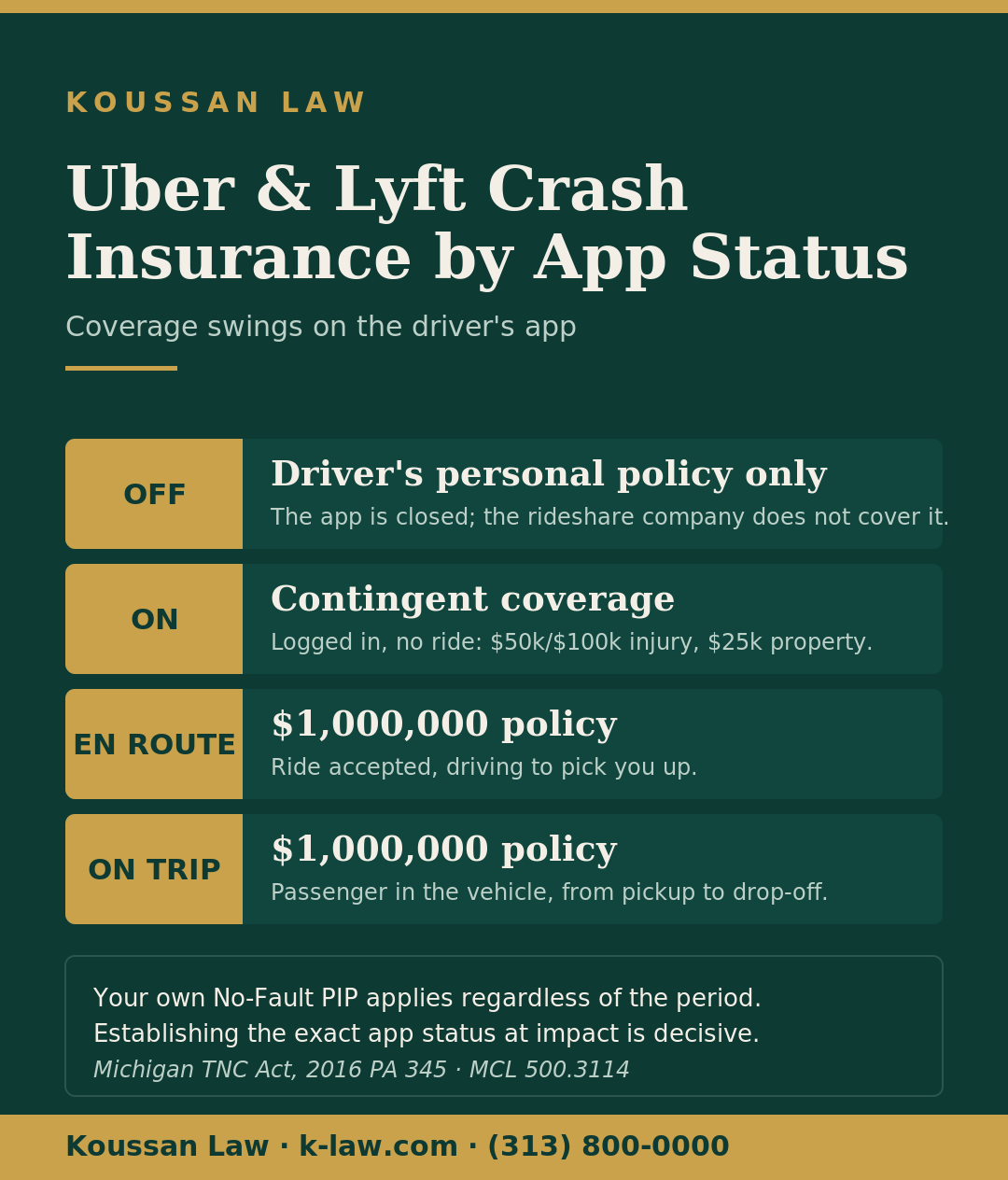
Rideshare insurance in Michigan is structured around the status of the driver's app. The periods break down as follows:
- Period 0 (app off). The driver is not logged into the Uber or Lyft platform. Only the driver's personal auto policy applies. The rideshare company's coverage does not respond at all.
- Period 1 (app on, waiting for a ride request). The driver is logged in and available but has not yet accepted a trip. Michigan's TNC law requires the company to maintain contingent liability coverage of at least $50,000 per person / $100,000 per accident for bodily injury and $25,000 for property damage. This coverage is typically contingent, meaning it applies on top of (or in place of) the personal policy.
- Period 2 (ride accepted, driver en route to pick up). The driver has accepted a trip and is driving to the passenger. The $1 million commercial liability policy is in effect.
- Period 3 (passenger in the vehicle). From pickup to drop-off. The $1 million commercial liability policy applies.
The practical consequence: a crash one minute before the driver accepts your ride may fall under a $50,000 contingent policy, while the same crash one minute after acceptance falls under a $1 million policy. This is why establishing the app status at the moment of impact is the central investigative task in every rideshare case.
Michigan's Transportation Network Company Act
Michigan regulates Uber, Lyft, and similar platforms under the Limousine, Taxicab, and Transportation Network Company Act (2016 PA 345), codified at MCL § 257.2101 et seq. The Act sets the insurance requirements described above, requires TNCs to maintain coverage that responds when a driver's personal insurer denies a claim, and obligates the platform to provide insurance information after a crash. The Act also bars personal auto insurers from being required to cover a loss that occurs while the driver is logged into the platform unless the policy specifically provides rideshare coverage, which is why the personal-versus-commercial coverage question is litigated so heavily.
No-Fault PIP for Rideshare Passengers and Drivers
Separate from the liability policies, Michigan No-Fault PIP pays for medical expenses, 85% of lost wages for up to three years, attendant care, and replacement services regardless of who caused the crash. The liability policy (the $1 million or the contingent coverage) pays for fault-based damages such as pain and suffering; PIP pays the economic losses no matter who was at fault. The two systems run in parallel.
The priority order for PIP under MCL § 500.3114, as restructured by the 2019 No-Fault reforms, generally directs an injured occupant to look first to their own auto policy, then to the policy of a resident relative, and then to the Michigan Assigned Claims Plan if no other coverage applies. The Assigned Claims Plan is significant in rideshare cases because many injured passengers (visitors, people who do not own a car, out-of-state riders) have no personal Michigan PIP policy of their own. The Plan provides PIP benefits capped at $250,000 with the standard No-Fault scope.
For the rideshare driver, the PIP picture depends on whether their personal policy includes the rideshare endorsement and on the commercial coverage in force during the active trip. For a pedestrian or cyclist struck by a rideshare vehicle, PIP applies under MCL § 500.3115 the same way it does for any pedestrian struck by a motor vehicle. See our Detroit pedestrian accident lawyer guide.
Who You Are in the Crash Changes the Analysis
- Rideshare passenger. Generally the most protected position. During an active trip, the $1 million policy is available for the at-fault driver's liability, whether the at-fault driver is your rideshare driver or another motorist. Your PIP runs through the priority chain above.
- Driver of another vehicle hit by a rideshare driver. Coverage depends entirely on the rideshare driver's period. Establishing app status is critical to whether you are looking at a $50,000 or a $1 million policy.
- Pedestrian or cyclist struck by a rideshare vehicle. Liability coverage depends on the period; PIP applies under MCL § 500.3115.
- The rideshare driver. Coverage depends on app status, the rideshare endorsement on the personal policy, and the commercial coverage in force.
The Trip-Period Dispute: Where These Cases Are Won or Lost
Because the available coverage can swing from $50,000 to $1 million based on the driver's app status, insurers have a powerful incentive to characterize the crash as occurring in a lower-coverage period. The dispute is resolved with electronic evidence that the platforms possess but do not volunteer:
- Trip and app logs. Uber and Lyft maintain second-by-second records of when a driver was logged on, when a request was sent, when it was accepted, and the GPS track of the trip. These records are obtained through preservation letters and formal discovery.
- Driver phone data. The driver's device records app activity and location.
- Vehicle telematics and event data recorder (EDR). Speed, braking, and timing data corroborate the sequence.
- Passenger account records. If you were the passenger, your own trip receipt and app history are direct evidence.
Sending a litigation-hold and preservation demand to Uber or Lyft early is essential, because app and trip data can be lost or become harder to obtain over time.
The Third-Party Tort Threshold for Pain and Suffering
To recover non-economic damages (pain and suffering, loss of enjoyment of life) from the at-fault party, the injury must meet the serious impairment of body function threshold under MCL § 500.3135. The McCormick v. Carrier, 487 Mich. 180 (2010) framework controls the threshold analysis: the impairment must affect an important body function and affect the person's general ability to lead their normal life. Serious rideshare-crash injuries (fractures, traumatic brain injury, spinal injury, surgeries) routinely satisfy the threshold. PIP economic benefits do not require meeting the threshold; they are payable regardless. For a deeper look, see our guide to Michigan's serious-impairment threshold.
Detroit Rideshare Crash Hotspots
Detroit's rideshare volume concentrates in predictable places, and so do the crashes:
- Detroit Metropolitan Airport (DTW). The single largest rideshare pickup and drop-off node in the region. The designated rideshare staging and pickup areas, the airport access roads, and I-94 and I-275 approaches generate heavy volume and frequent crashes.
- Downtown and the entertainment district. Little Caesars Arena, Comerica Park, Ford Field, and the Fox Theatre district surge with rideshare traffic on event nights, with congested pickup zones and impaired-driver risk after events.
- Greektown and the casino corridor. Late-night rideshare demand around Greektown Casino, MGM Grand Detroit, and MotorCity Casino, with elevated impaired-driving exposure.
- Corktown and Midtown nightlife. Bar and restaurant districts with heavy late-night pickup activity.
- Wayne State University and the Medical Center. Student and hospital-visitor rideshare traffic along Woodward, Cass, and the Mack/Brush corridors.
- The freeway approaches. I-75, I-94, I-96, M-10 (the Lodge), and the Davison carry rideshare trips between downtown, the airport, and the suburbs, where higher speeds produce more severe injuries.
Damages Available in a Detroit Rideshare Accident Case
- Past and future medical expenses, paid by PIP up to the applicable tier or Assigned Claims Plan cap, supplemented by the third-party claim.
- Lost wages, 85% of gross for up to three years under PIP, with longer-term wage loss available through the third-party tort claim for serious injuries.
- Attendant care and replacement services under MCL § 500.3107, subject to the post-2019 caps.
- Pain and suffering and loss of enjoyment of life, third-party tort, requires meeting the serious-impairment threshold.
- Loss of consortium for a spouse.
- Wrongful death damages under MCL § 600.2922 in fatal cases. See our Detroit wrongful death lawyer guide.
Comparative Fault
Michigan follows modified comparative negligence under MCL § 600.2959. A plaintiff found more than 50% at fault cannot recover non-economic damages, and any recovery is reduced by the plaintiff's percentage of fault. In rideshare cases this most often arises in multi-vehicle collisions where fault is contested among the rideshare driver, other motorists, and sometimes the passenger.
Statute of Limitations for Detroit Rideshare Cases
- 3 years from the date of injury for the third-party tort claim under MCL § 600.5805.
- 1 year for No-Fault PIP benefit claims from the date the expense was incurred under MCL § 500.3145.
- 120 days for written notice to a government entity under MCL § 691.1404 if a government vehicle (such as a DDOT or SMART bus) is involved.
Wayne County Circuit Court for Detroit Rideshare Cases
Rideshare-accident lawsuits arising in Detroit are filed in the Third Judicial Circuit Court (Wayne County Circuit Court), with the main courthouse at the Coleman A. Young Municipal Center, 2 Woodward Avenue, Detroit. Cases involving out-of-state corporate defendants or federal questions may instead proceed in the U.S. District Court for the Eastern District of Michigan.
What to Do After an Uber or Lyft Crash in Detroit
- Get medical evaluation. Some serious injuries (closed-head injury, internal trauma) present hours or days later. Documented care creates the medical baseline. Some crash injuries are delayed and surface days later.
- Screenshot your trip in the app. If you were the passenger, capture the trip receipt, driver name, vehicle, and timestamps before they scroll out of reach. This is direct evidence of the active-trip period.
- Get the police report. Ensure a UD-10 crash report is filed; request the report number.
- Photograph the scene, vehicles, and injuries, and note the rideshare driver's app status if you can observe it.
- Identify witnesses and any surveillance (airport cameras, business cameras, arena and casino security).
- Do not give a recorded statement to any insurer (the driver's, the platform's, or your own) before speaking with counsel.
- Engage counsel quickly so a preservation demand for the Uber or Lyft trip and app data goes out before it becomes harder to obtain, and so the PIP application clock is protected.
Settlement Realities
Rideshare cases turn on two variables: the severity of the injury and which coverage period (and therefore which policy limit) applies. A serious injury during an active trip, with the $1 million policy in play, supports substantially higher recovery than the same injury during the app-on-waiting period with only contingent coverage. Identifying every available policy (the platform's commercial coverage, the driver's personal policy, any other at-fault motorist's coverage, and your own underinsured-motorist coverage) is the work that determines the ceiling on recovery. Past results do not guarantee future outcomes; every case is fact-specific.
Frequently Asked Questions: Detroit Uber and Lyft Accident Lawyer
Q: I was a passenger in an Uber that crashed in Detroit. What coverage applies? During an active trip (you were in the vehicle), Uber's $1 million commercial liability policy applies to the at-fault party, and your medical bills and wage loss are covered by No-Fault PIP through the priority chain under MCL § 500.3114. Being a passenger is generally the most protected position.
Q: The Uber driver was logged in but had not picked me up yet. Does that change anything? Yes. If the driver had already accepted your trip and was en route, the $1 million policy applies. If the driver was merely logged on and waiting (no accepted ride), only the lower contingent coverage applies. The exact app status at impact is the decisive fact.
Q: I don't own a car and have no Michigan auto insurance. Can I still get PIP after a rideshare crash? Likely yes, through the Michigan Assigned Claims Plan, which provides PIP benefits (capped at $250,000) to injured people who have no other applicable coverage. This is common for rideshare passengers and visitors.
Q: Another car hit my Uber. Do I sue the other driver or Uber? The claim follows fault. If the other driver caused the crash, their liability policy is primary, and your underinsured-motorist coverage or the rideshare policy may supplement it. Your PIP applies regardless of fault. The analysis is fact-specific.
Q: How do you prove which rideshare period was in effect? Through the platform's trip and app logs, the driver's phone data, vehicle telematics, and (if you were the passenger) your own app records. A preservation demand to Uber or Lyft early in the case secures this evidence.
Q: How long do I have to bring a Detroit rideshare claim? Generally three years from the date of injury for the tort claim under MCL § 600.5805, but only one year for PIP benefits under MCL § 500.3145, and 120 days for notice if a government vehicle is involved. Act well before these deadlines.
Q: How much does a Detroit rideshare accident lawyer cost? Contingency fee. Standard structure: 33⅓% of the recovery pre-trial, sometimes 40% if the case goes to trial. Costs reimbursed from the recovery. No upfront cost, and no fee unless we recover.
Speak With a Detroit Uber and Lyft Accident Lawyer
If you were injured in an Uber or Lyft crash in Detroit or anywhere in Wayne County, as a passenger, another driver, a pedestrian, or the rideshare driver, contact Koussan Law for a free, confidential consultation. The coverage-period analysis and the early preservation of the platform's trip data can make the difference between a $50,000 case and a $1 million case. We accept Michigan rideshare cases on contingency; you pay nothing unless we recover. Our trial record includes a $14.95 million jury verdict against Pontiac General Hospital, a $6 million premises liability settlement, a $1 million wrongful death settlement, and arguments before the Michigan Supreme Court. Call (313) 800-0000, request a consultation online, or use our free case calculator. Spanish and Arabic language services available.
Related Resources
- Detroit Personal Injury Lawyer
- Wayne County Personal Injury Lawyer
- Auto Accident
- Michigan No-Fault Attorney
- Detroit Car Accident Lawyer Guide
- Detroit Truck Accident Lawyer Guide
- Detroit Pedestrian Accident Lawyer Guide
- Detroit Motorcycle Accident Lawyer Guide
- Detroit Wrongful Death Lawyer Guide
- Drunk Driving Accident Claims in Michigan
- Distracted Driving in Michigan: Statistics and Liability
- Michigan's Serious-Impairment Threshold Explained
- Amazon and Delivery-Vehicle Accidents in Michigan
- Michigan Personal Injury Case Value Guide
Past results do not guarantee future outcomes. Every rideshare accident case is fact-specific and depends on the coverage period in effect, the available policies, the No-Fault PIP priority chain, the threshold-of-injury analysis, the comparative-fault apportionment, and qualified expert review. The coverage figures referenced reflect Michigan's TNC insurance requirements and the rideshare platforms' standard policies and can change. This article is for general informational purposes and is not legal advice. Reading this article does not create an attorney-client relationship with Koussan Law.