Michigan No-Fault Law, section by section › MCL 500.3109a
Offering deductibles and exclusions reasonably related to other health and accident coverage; exclusion for qualified health coverage; reduced premium rates; applicability of exclusion; termination of qualified health coverage; refusal to insure for failure to obtain certain security prohibited; amount of premium reduction.
In plain terms
Insurers may offer coordinated (excess) PIP at a reduced premium. For policies issued or renewed after July 1, 2020, an insurer must offer anyone choosing the $250,000 level an exclusion for household members who have qualified health coverage, with the PIP medical premium reduced 100% for a fully covered household. A person whose health coverage ends must add PIP medical within 30 days or lose PIP medical benefits for an accident during the gap, though the assigned claims plan is available during that window.
How this section works in practice
This section governs "coordinated" PIP, the cheaper option that makes health insurance primary. Under subsection (1) an insurer may offer deductibles and exclusions tied to other health and accident coverage, at a reduced premium approved by the director. With coordinated coverage the health plan pays first and PIP pays whatever the health plan does not, including copays, deductibles and services the health plan excludes, such as attendant care.
The 2019 reform added the qualified-health-coverage exclusion in subsection (2). A customer who selects the $250,000 PIP level and whose household all have qualifying health coverage can exclude PIP medical for those people and pay nothing for that portion of the premium. If the health coverage ends, the household has 30 days to add PIP medical; during the gap an injured excluded person can claim through the assigned claims plan, but after a missed deadline the accident is uncovered except by other policies. Employer plans that exclude auto injuries are common, so anyone considering the exclusion should read the health plan's language, not just the summary of benefits.
Text of MCL 500.3109a
Sec. 3109a.
(1) An insurer that provides personal protection insurance benefits under this chapter may offer deductibles and exclusions reasonably related to other health and accident coverage on the insured. Any deductibles and exclusions offered under this section must be offered at a reduced premium that reflects reasonably anticipated reductions in losses, expenses, or both, are subject to prior approval by the director, and must apply only to benefits payable to the person named in the policy, the spouse of the insured, and any relative of either domiciled in the same household.
(2) For an insurance policy issued or renewed after July 1, 2020, the insurer shall offer to an applicant or named insured that selects a personal protection benefit limit under section 3107c(1)(b) an exclusion related to qualified health coverage. All of the following apply to that exclusion:
(a) If the named insured has qualified health coverage as defined in section 3107d(7)(b)(i) that will cover injuries that occur as the result of a motor vehicle accident and if the named insured's spouse and any relatives of either the named insured or the spouse domiciled in the same household have qualified health coverage that will cover injuries that occur as the result of a motor vehicle accident, the premium for the personal protection insurance benefits payable under section 3107(1)(a) under the policy must be reduced by 100%.
(b) If a member, but not all members, of the household covered by the insurance policy has qualified health coverage that will cover injuries that occur as the result of a motor vehicle accident, the insurer shall offer a reduced premium that reflects reasonably anticipated reductions in losses, expenses, or both. The reduction must be in addition to the rate rollback required by section 2111f and the share of the premium reduction for the policy attributable to any person with qualified health coverage must be 100%.
(c) Subject to subdivision (d), a person subject to an exclusion under this subsection is not eligible for personal protection benefits under the insurance policy.
(d) If a person subject to an exclusion under this subsection is no longer covered by the qualified health coverage, the named insured shall notify the insurer that the named insured or resident relative is no longer eligible for an exclusion. All of the following apply under this subdivision:
(i) The named insured shall, within 30 days after the effective date of the termination of the qualified health coverage, obtain insurance that provides the security required under section 3101(1) that includes coverage that was excluded under this subsection.
(ii) During the period described in subparagraph (i), if any person excluded suffers accidental bodily injury arising from a motor vehicle accident, the person is entitled to claim benefits under the assigned claims plan.
(e) If the named insured does not obtain insurance that provides the security required under section 3101(1) that includes the coverage excluded under this subsection during the period described in subdivision (d)(i) and the named insured or any person excluded under the policy suffers accidental bodily injury arising from a motor vehicle accident, unless the injured person is entitled to coverage under some other policy, the injured person is not entitled to be paid personal protection insurance benefits under section 3107(1)(a) for the injury that occurred during the period in which coverage under this section was excluded.
(3) An automobile insurer shall not refuse to prospectively insure, limit coverage available to, charge a reinstatement fee for, or increase the premiums for automobile insurance for an eligible person, as that term is defined in section 2103, solely because the person previously failed to obtain insurance that provides the security required under section 3101(1) in the time period provided under subsection (2)(d)(i).
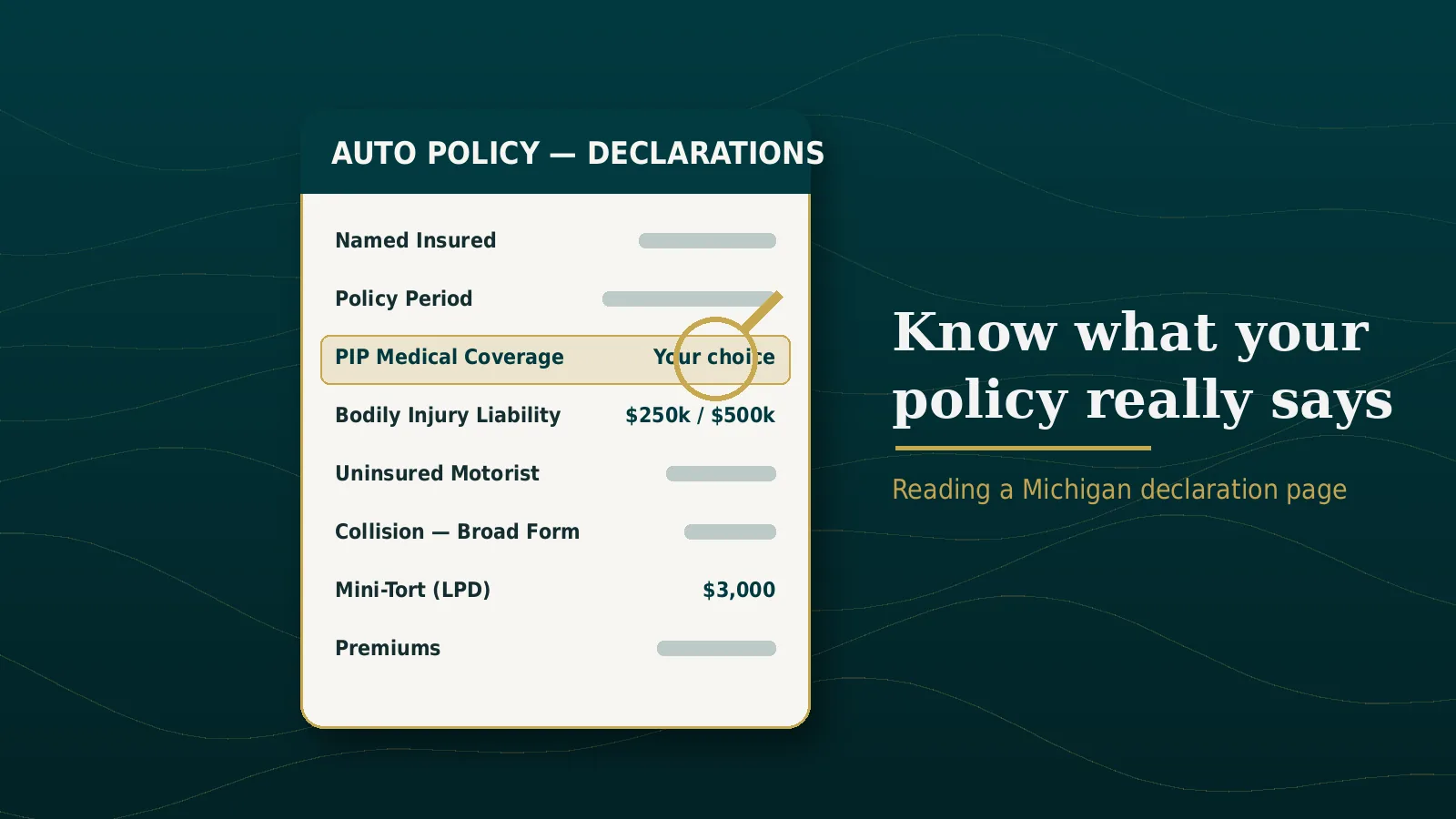
(4) The amount of a premium reduction under subsection (1) must appear in a conspicuous manner in the declarations for the policy, and be expressed as a dollar amount or a percentage.
(5) As used in this section, "qualified health coverage" means that term as defined in section 3107d.
History: Add. 1974, Act 72, Eff. June 4, 1974 ;-- Am. 2012, Act 454, Imd. Eff. Dec. 27, 2012 ;-- Am. 2019, Act 21, Imd. Eff. June 11, 2019 ;-- Am. 2019, Act 22, Imd. Eff. June 11, 2019
Source: MCL 500.3109a at legislature.mi.gov (official text). Text as published in the 2025 Michigan Compiled Laws; reviewed by Koussan Law on September 15, 2026.
Sections this one refers to
- MCL 500.3107c: Choosing a PIP Medical Coverage Level
- MCL 500.3107d: Opting Out of PIP Medical With Medicare
- MCL 500.3107: What PIP Pays: Medical, Wage Loss, Services
- MCL 500.3101: Who Must Carry No-Fault Insurance
Sections that refer to this one
- MCL 500.3101: Who Must Carry No-Fault Insurance
- MCL 500.3104: The Michigan Catastrophic Claims Association
- MCL 500.3107c: Choosing a PIP Medical Coverage Level
- MCL 500.3114: Priority: Which Insurer Pays PIP
- MCL 500.3135: Serious Impairment Threshold and Mini Tort
- MCL 500.3172: Claiming Through the Assigned Claims Plan
Practice pages
Important: This is not legal advice
This article is general information about Michigan personal injury law. It is not legal advice and should not be relied on as a substitute for consultation with a licensed Michigan attorney about your specific situation. The laws, deadlines, procedures, and frameworks here are general guidelines that may or may not apply to your case.
Every personal injury case turns on its own unique facts. The timing, the parties, the evidence, the jurisdiction, the insurance available, and dozens of other variables can change the legal analysis. Do not rely on anything written on this website to make decisions about your case.
If you have been injured in Michigan, the only responsible step is to speak with a licensed Michigan attorney about your specific facts. Call Koussan Law at (313) 800-0000 for a free consultation, or contact a different Michigan personal injury attorney of your choosing.
Reading this article does not create an attorney-client relationship with Koussan Law. Past results do not guarantee future outcomes.